
Have a question?
Contact us
The Association for Advancing Physician and Provider Recruitment (AAPPR) is redefining recruitment to retention and is the only professional organization where physician and provider recruitment leaders and others who influence recruitment, onboarding and retention can connect, learn and advance their careers.

AAPPR will launch a new course geared towards new recruitment professionals in a few weeks. If you are new to the provider recruitment world, welcome! You have taken the absolute best first step by joining AAPPR to further your professional growth and development. Below are several tips for new and seasoned recruitment professionals. After all, a seasoned recruiter knows our landscape is ever-changing, so our recruitment tactics must also continuously evolve.
Five Atypical Recruitment Tactics
We’re all familiar with the adage, “Speak less, listen more.” While it may appear as a fundamental principle, it is sometimes underestimated. After all, as recruiters, we thrive on conversations! After all, we’re recruiters- we love to chat! We are in this position for a reason: to sell our organization. Listening more actually helps us better connect with and understand our candidates better. Listening more allows us time to craft our responses while we navigate the conversation eloquently.
Know what you’re up against. Setting expectations within your organization is key. Research the competing offers, know how many physicians are available for the specialty needed, and provide average days to fill data. Every organization’s recruitment processes look different, and if you’re recruiting a resident/fellow, this may be their first time interviewing. Setting expectations for the candidate is also critical so they can be prepared for the next steps, and your department can show how organized and efficient it is.
Understanding your candidate’s motivators relates to my initial tip of active listening. It’s a crucial aspect, which is why I prioritize it by making it one of my first questions during our conversation. Understanding what is important to the candidate professionally and personally should be the hub of the conversation. Knowing their interests allows you to connect and sell your community, the position, and the health system.
Quality is better than quantity. Be selective as to who you invite in for a site visit. Our 2022 AAPPR Benchmarking Report shows that 85% of provider recruiters are female, so you will appreciate my following sentiment. While shopping, you should only buy the item if it will bring you joy. Only host candidates you believe will be an excellent fit for the practice and community. Once that candidate is identified, go all out on customizing the visit based on their interests and motivators.
Once the site visit is complete, you are exhausted, and let’s face it, you’ve been away from your computer all day, and the emails have added up. Be sure to close the loop and extend an offer in a timely fashion. Furthermore, after the recruited provider has signed the contract and is preparing to relocate, maintain ongoing communication to keep them informed about the health system and the community. This commitment to communication contributes to successful physician retention. Physician retention is important, and it starts once they execute their contract.
Happy Recruiting!

With my AAPPR Board Presidency term recently ending, along with receiving a promotion into a larger leadership role at work, the concept of good leadership has been on my mind. We are all leaders in what we do to some extent – whether it’s leading cross functional teams or leading our book of work. We have a direct impact on the revenue and success of our organizations. And we seek a seat at the table to influence executives and business leaders because we are the experts in our space. In my first official manager role, I had no idea what I was doing and learned through some tough feedback that there is always opportunity for growth. Managers drive employees, while employees follow leaders. Creating a following can start at any role level.
Here are some key lessons that I’ve learned along the way…
1. A leader is only as good as the people they surround themselves with: I heard a leader say this once and it stuck. I now use it all the time with my teams. Don’t surround yourself with just “yes people.” Make a point to build a team or network of people who challenge you to think differently. Who bring different perspectives and experiences to the table. Who seek to understand, not just do. And empower your teams to be the leaders and owners of their work. A leader’s success is not theirs alone. It belongs to their team, and it is the leader’s job to empower and lift their team to do their best work.
2. Don’t be afraid to fail: The greatest opportunity we have to grow is in our most challenging moments. Be open to feedback. It’s OK to fail, but fail fast and then fix it. Nothing is ever perfect from the start, but it is in failure that we often learn how to thrive.
3. Cast a big shadow: Be purposeful in your interactions and think about how they impact others. Hold yourself to the same standards that you do others and model the behavior that you want to see in others. Good leaders are human – they are accessible and relatable, and they care about interactions at every level.
4. Leadership can be the loneliest place:As leaders we are responsible for making decisions that can have far-reaching consequences. At times, the toughest decisions we make are the ones that others cannot. We must learn how to separate the personal and emotional side of ourselves from our decision-making. Never is this truer than when you are in a position to make decisions that you know will impact the people you care about on your team.
5. When you put people first, they’ll give you their best: This is where authenticity – and even a little emotion – lives. Leading by fear only creates a team that underperforms. Have genuine concern for the well-being and development of your people – strive for meaningful relationships as you work towards a common goal. This is where you find human connection and aligned beliefs and behaviors.
In our often-unforgiving world of navigating executives and business partners while trying to meet hiring needs in a talent segment that’s facing extreme shortages – we lead strategy, we lead relationships, we lead impact. Leadership isn’t a time or point in your career. You don’t have to be in the executive suite to model leadership behavior or influence change. It’s not a title or a team that makes others value your input. It’s the mutual respect and credibility that you develop through your relationships and the demonstrated value that you bring to the table that makes you a strong leader.

Who loves a good strategic planning session? I do! The thought of heading into the war room filled with flip charts, sharpies, endless amounts of sticky notes, and everyone’s oversized coffee cup to keep them hopped up on caffeine is exciting. Your creative juices flowing, sharpening the pencil, feverishly writing down your thoughts and then feverishly scribbling it out as you come up with a better way to phrase it. All in the pursuit of creating an inspiring mission, vision, values, and action plan to carry them out.
So, what exactly is strategic planning, and how can it help you and your organization achieve your goals? According to Harvard Business School Strategic planning is defined as the ongoing organizational process of using available knowledge to document a business’s intended direction. This process is used to prioritize efforts, effectively allocate resources, align shareholders and employees on the organization’s goals, and ensure those goals are backed by data and sound reasoning.
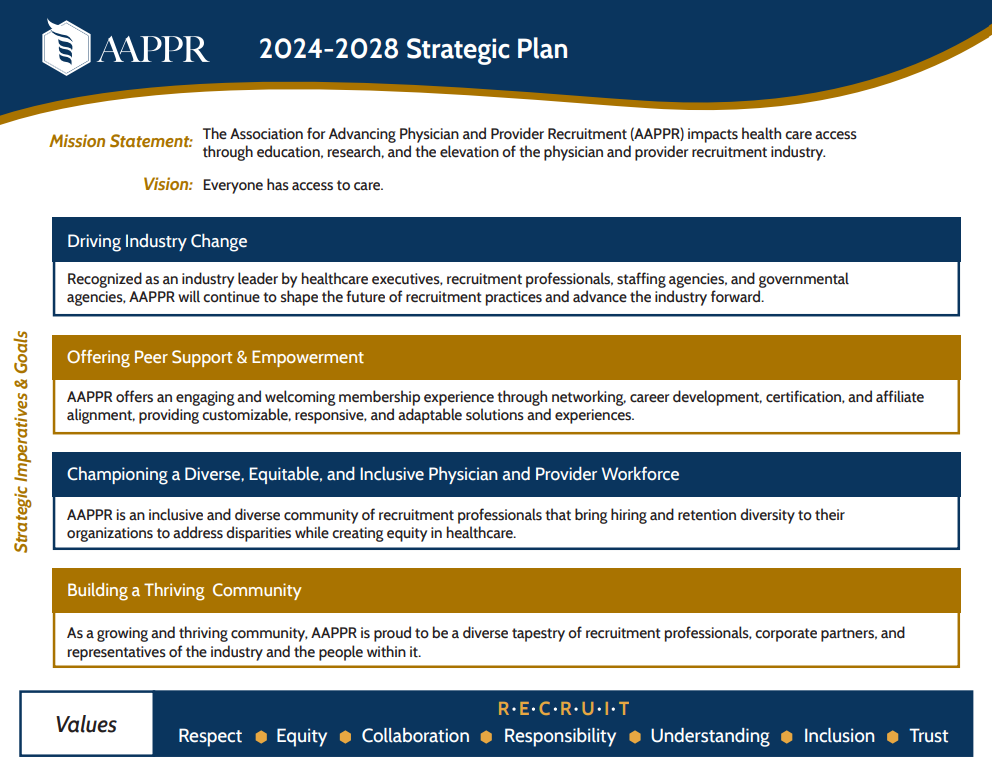
My fellow board members and I recently completed a strategic planning session to create a new mission, vision, and values (MVV) statement for AAPPR. These statements were shared in June’s Pulse Newsletter. If you missed it don’t worry, we are planning for a bigger launch of the landscape plan and the MVV later this year.
What I loved about the planning session, and many follow-up discussions, was how everyone really participated in the process. We all strived to come up with a well-written strategic plan that will play a pivotal role in the growth and success of AAPPR. With the rapidly changing landscape and challenges in provider recruitment the board worked hard to provide clear goals and objectives for the organization. The new strategic imperatives will help position AAPPR as an industry expert, strengthen the value of membership, champion a diverse, equitable and inclusive physician and provider workforce, and diversify and grow the membership and customer base.
I want to express my deep admiration and appreciation for my fellow board members for their time and dedication in planning and paving the future of AAPPR.
Thank you,
Doug Lewis

In April, Stephanie Wright, MSA, CMPE, CPRP, Marjorie Alexander, MBA, CPRP, RMSR
(fellow board members), Christy Ricks, MHA, CPRP-DEI (AAPPR member and former Vendor Committee Chair), and I were accepted to sit on panels at Becker’s Hospital Review Annual Meeting in Chicago, IL.
Becker’s Hospital Review is a well-known medical industry trade magazine and online newsletter. The audience at the Annual Meeting was over 420 hospital and health system executives. In other words, our target audience.
One of the top board imperatives is to increase the visibility of AAPPR and the profession. Part of this work includes targeting the C-Suite to create a cultural shift where they start to rely on their in-house recruitment professionals and consultants as subject matter experts and trusted advisors.
We were extremely excited to get this opportunity and a seat at the table…finally. Our panel topics included Physician Contracting Over the Next 5 years, Physician Pay in Value-Based Care, The Impact of Empathy on Burnout and Healthcare Economics. Our fellow panelists included Chief Medical Officers, Chiefs and Vice Chiefs, Clinical Officers, Chief Administrative Officers, and Medical Directors.
When I first saw the agenda, I was slapped with a heavy dose of imposter syndrome. I immediately felt like I did not deserve to sit on this panel. But this was a once-in-a-lifetime opportunity, and I did not want to let myself or AAPPR down, so I forged ahead.
I am happy to report that Becker’s was a wild success, and I was left with two major takeaways.
First, the feeling of imposter syndrome is real, but you have to fake it until you make it. Because, in reality, you’re not really faking it, you’re actually doing it.
To ensure I could hold my own amongst a panel of C-Suite leaders and Executives. I over-prepared and then prepared again. I was also thoughtful about how I could speak about data from AAPPR and best practices from our profession to bring home the point that provider and physician recruiters are the subject matter experts in our space. At the end of the day, our roles give us the unique opportunity to learn about physicians’ and providers’ motivations and drives. We see the impacts that our healthcare system is having on these key clinical staff members firsthand.
After my panel discussion, I was left feeling accomplished and validated that our work makes us amazing spokespeople for offering thought leadership around the challenges that we face in healthcare today.
With that takeaway, an even more exciting realization was confirmed. We deserve a seat at the table, and this audience wants to hear what we have to say. Stephanie, Marjorie, Christy, and I were all blown away by how receptive our audiences were. Throughout our careers, many of us have felt like we have been on the hamster wheel, fighting for that seat at the table with our C-Suite and Executive leadership.
After attending Becker’s, I realized something. Rather than waiting to be invited to the table, we need to just show up and take our seats. Becker’s didn’t reach out to us, we reached out to Becker’s. We took that seat, and we were amazingly well received.
As a board, we are committed to increasing visibility for AAPPR and our profession. But at the same time, I challenge our members to look for opportunities to take their seats at the table. Don’t wait to be asked. You would not be successful in this profession if you did not know what you were talking about. Have faith in your expertise, and don’t listen to the imposter voices, because I promise you, you’ve got this!
As we enter our traditional busy summer season for Physician Recruitment, it is essential to prioritize balance while pushing ourselves and our teams to meet the high demands of our recruitment goals. Work-life balance is not just noise; it has become fundamental to achieving optimal results and fostering high-level productivity. Finding balance helps recruitment professionals avoid a reduction in productivity while remaining resilient to continue to meet the pace of our industry. Here are some ways to balance goals, avoid burnout, and build resiliency.
Setting expectations with leadership and providing information to hiring leaders and senior leadership regarding the busy summer season is vital. Leaders need to be reminded of the basics and current market conditions. Summer is a hot time for recruitment because practicing physicians are renewing their current contracts. While prospective 2024 candidates are eager to begin their job search. Leaders must understand that the team must act quickly and clearly to accept/reject candidates. It’s a seller’s market for Physician recruits, and they know it. Having the hiring goals finalized to be prepared to answer all questions and explaining any nuances related to the particulars of the position will be critical as there is little time to gather responses from the team and present them to candidates before they move to the next job for consideration.
Monitor processes to look for improvement, reviewing workflows to ensure targets are being met and how they could be addressed if there are any lags. Often during the summer vacation, schedules can impede and extend the timeframes, ensuring measures are taken to keep candidates flowing through the process quickly. Take steps to keep the momentum going even if the regular business partners are not available.
Levering Tech for productivity, in this error of Physician Recruitment, we have many advantages with full utilization of our tools. We cannot only use technology to schedule emails and text messages to be sent out when we are away from our desks but also to leverage the best practices for our specific situations. Most of us have access to one or more tools for advertising and marketing resources, for example, PracticeLink, Doximity, PracticeMatch, etc. These tools provide us with valuable advantages when it comes to accessing our recruitment data. By utilizing these tools beyond their basic functions of job posting and sending out job-related emails, we can unlock additional benefits. Leverage these tools to research what is working (email outreach, postings, etc.) provide insight to the interest of your advertisements, we can target competitors, find out how many graduates are available in our markets, etc.
Using established relationships, check in with past recruits for feedback about working at the organization. Of course, our goal is to get new leads, but we can also leverage this conversation to get ideas about how working is different (for better or worse) than expected. Holding talks with past recruits also serves as a retention checkpoint for the organization to get a feel of the current mindset of the candidate. Remember, you established the original trust with the candidate and brought them into the company, and that is all about relationship, communication, and trust.
Taking time to pause, remote work has its advantages, but it also has our teams sitting longer, working longer without a pause for mental refreshment. I encourage my team to block time in their daily schedules to step away from their work area and go into another room, breath, stroll around the block, send a gratitude text/email to a friend or co-worker, etc. The thought is to engage other parts of our brains and build flexibility into the workday to sustain our hope of positive outcomes.
We must focus on balance and resiliency to maintain our talents within this industry, as many of us suffer as we try to meet the high demands and remain high-functioning people. Turnover within Physician Recruitment is higher than ever. Retaining our talent in the industry is crucial for us to remain sustainable; we must pause and reset physically and mentally to stay effective.

Have you ever wondered how our candidates experience their interactions with us? How do we compare? We think we provide them with a WOW experience, but do we really? In general (not clinical specific), 49% of job applicants decline a job offer due to poor candidate experience. As we all know, a job search can be one of the most stressful things in life.
How does our job seeker feel about our organization as a potential employer, based on their interactions with us throughout the entire recruitment process? There are many touchpoints during the Talent Lifecycle, from job boards and conferences to conversations with sourcers, recruiters, coordinators, hiring managers, credentialers, onboarders, and trainers.
It is a good idea to review your recruitment process from beginning to end to determine if it meets your and your organization’s expectations—a good review can expose gaps that need addressing. Measuring candidate experience can be tricky. However, you can learn much through surveys, application abandonment rates, decline reasons, and referral rates.
Some best practice tips for a positive candidate experience process include:
A poor candidate experience can risk losing top talent and might harm your organization’s reputation. Poor reviews might dissuade other candidates from considering your organization.
A better candidate experience will lead to better outcomes. We all want to hire and retain top talent, but losing someone because of a poor candidate experience would be a real miss in today’s recruitment climate.

Chief of Neurology: “Well, with all due respect, I’m not confident that you will fill this search for me”
Physician Recruiter: “If in six months I’m unable to find well-qualified candidates for you to consider, I promise not to bother you again”
And that’s how my first meeting as the new Physician Recruiter ended with Dr. Karoubi, my first client. His neurology position had gone unfilled for two years and he’d never worked with a specialized recruitment professional before. Within 90 days, I presented three excellent candidates to him: he hired one, created a new position for another, and eliminated a multi-million dollar contract with a specialty group. With that, Dr. Karoubi became my first Ally!
Transforming my health care system by introducing and establishing a physician recruitment operation has been quite the journey. Having this Ally became a game changer since physician recruiters were non-existent – and not welcomed – in the beginning. While I made the ‘rounds’ championing the value of the physician recruiter, Dr. Karoubi shared his experience – and results – with fellow department heads and executive leaders. Pretty soon, I had a growing network of allies that championed me and the physician/provider recruiter role. This allowed me to focus exclusively on sourcing for top talent and providing a concierge-like experience to my clients while my Allies cleared pathways and silenced the naysayers.
Now, 14 years since that first meeting, our operation has grown from the original team of six to more than 100 projected physician/provider recruiter hires by the end of 2023. What I learned from Dr. Karoubi, and others that followed, is I did not bear this change management burden alone! I credit this network of Allies with making the physician/provider recruiter role a permanent component of our health care system. There are two simple ways I keep those Allies working for me:
Engagement – Whether I’m working on a search or just ‘checking in’, I keep in touch with my allies. An email to remind them I’m one text or IM away to deliver solutions for them, a visit to their department just to say ‘hi’ or simply connect. This strengthens our partnership and further solidifies me as the provider recruitment subject matter expert.
Enlightenment – No, not in a TedTalk kind of way. I send the latest on what’s trending in the provider market and our industry for Ally-awareness – AAPPR Benchmark Studies and White Papers, Becker’s Hospital Review, Modern Healthcare, etc. This keeps us connected even when I’m not working a search for them.
Over the years, I’ve learned to lean on my allies as key strategic partners that champion our profession, at the most critical stages of this transformational journey. I challenge you to do the same by keeping your alliances alive!

Emerson Moses, MBA, CPRP-DEI, shared in her post last month how AAPPR made amazing strides in 2022 to expand the reach and visibility of the association. We have created great momentum and are now off and running into 2023. We have accomplished this through many strategic imperatives, but one of our most important goals is to ensure we maximize value for our members. One of the ways we do that is by offering a diverse suite of professional development opportunities.
Professional development and recruiter education is a cause that is near and dear to my heart. I would not be where I am in my career today without the help of AAPPR. Many moons ago when I first stumbled into a role in provider recruitment as a coordinator, I was a one-woman show with no mentorship or guidance internally. I had no idea what I was doing, and my phone was ringing off the hook. The best advice I ever got was to join AAPPR and get my certification. Within two years of starting my role, I sat for my certification and never looked back.
Many of my fellow board members have had similar experiences or can deeply relate to this sentiment. These experiences have informed how we prioritize the importance of educational opportunities for our members. Outside of the Certified Physician and Provider Recruitment Professional (CPRP) certification we have many educational offerings. In addition to our courses, we also host monthly round tables and webinars. Our webinars have always been a staple of AAAPR’s educational contributions, and we continue to collaborate with our affiliates and corporate partners to offer a wide scope of content related to every facet of our roles.
Over the last few years, we have worked diligently to expand our course offerings outside of the CPRP. We have launched an Onboarding and Retention Certificate, Locum Tenens Management Certificate, and our Diversity, Equity, and Inclusion Micro Certificate. We identified a gap in introductory education for new members, which led us to develop an Introduction to Recruitment course, which will launch later in 2023.
We continue to prioritize our education offerings as an association because the board understands that when our members succeed, so does AAPPR. Helping our members elevate themselves as professionals allows them to position themselves as subject matter experts within their organizations. This, in turn, creates more visibility and credibility for members and the association.
This year, whether you are new to the field or a seasoned professional, I challenge you always to strive to continue to learn and take advantage of all our educational offerings. Whether that is attending monthly roundtables or joining us at conference in Austin, TX in March, it will make an impact. Together our members and AAPPR will continue to grow and establish ourselves as “The Association and The Professional” for all things provider and physician recruitment.

As the year starts to wind down, and the seasons change, I naturally find myself in a state of reflection. Even more so this year, knowing that my time as President of the Board of Directors will soon come to an end. But before that happens, we have several critical months ahead of us where the Board will dive into our strategic plan for the next 3-5 years. Last week we brought our AAPPR Team, Board and Affiliate Leaders together in Salt Lake City to discuss the future, but it also gave us a chance to share with excitement all that is already happening with the Association! And we have much to be proud of!
Firstly, AAPPR Membership surpassed 2,000 members for the first time this year! We expanded CPRP eligibility and saw our new and legacy certifications climb to almost 700 – and growing! The AAPPR Benchmark report has been viewed and purchased this year (in just 2 months since publication) by almost 30% more organizations than the entirety of 2021! And AAPPR Membership retention has risen to 88% and includes over 500 new members. That just blows my mind – and it tells me that the strategic vision of the Board, and the implementation and management of Carey Goryl and her team has us on the right track.
I am also excited to share that this year we have engaged the support of a Media Relations firm, Franco, to further position the Association and our members as THE thought leaders in the space of Physician and Advanced Practice Provider Recruitment, Onboarding and Retention. Positioning our CEO, Carey Goryl, as the voice of the association was intentionally done to expand our ability to engage in new conversations across C-Suite leaders, healthcare media and the public. The AAPPR Benchmarking report was picked up by Beckers, The Advisory Board, Modern Healthcare, and at least 94 other news sources! We have Board members speaking at Becker’s Healthcare Conference in 2023, and several more sessions in the works! AAPPR and our leaders are also being featured in interviews with multiple leading healthcare publications.
The share of voice of AAPPR in the media when it comes to the work that all of you do is continuing to grow – and we are excited to see what the next year will bring!
There are so many more accomplishments, initiatives, and visions that we have seen come to life this year that I would need several months to cover it all. At the end of the day, I am incredibly proud of this Association – of a Board of Directors who isn’t afraid to shake things up, challenge what has always been and take us into the next phase of our profession; of a CEO and leader that enthusiastically is on this journey with us and never hesitates to push us to think bigger and better; and of our members who tirelessly, day in and day out, do what you do so exceptionally and so passionately that it almost brings me to tears.
Buckle up, my friends – 2023 is only going to get better! More white papers, expanded media presence and a continued drive towards bringing each of you the solutions that you need to do your best work and make the greatest impact in your communities. Not to mention our Annual AAPPR Conference in Austin featuring Keynote speakers Risha Grant and Valerie Alexander! Registration is open!
Take time to reflect yourselves this winter season – on all that you do, and all that you have accomplished. Enjoy your loved ones, your traditions and celebrate yourselves. You deserve it. Because you are, quite frankly, remarkable.
AAPPR uses cookies for functional and analytical purposes. By continuing to browse or by clicking “Accept,” you agree to the storing of cookies on your device to enhance your site experience. To learn more about how we use cookies or how to change your settings, please see our privacy policy.
Accept Close