Have a question?
Contact us
The Association for Advancing Physician and Provider Recruitment (AAPPR) is redefining recruitment to retention and is the only professional organization where physician and provider recruitment leaders and others who influence recruitment, onboarding and retention can connect, learn and advance their careers.

Each year, Physician and Provider Recruitment Professionals (PPRP) Week serves as an opportunity to recognize and elevate the critical work done by recruitment professionals across the healthcare industry.
Successful recruitment is rarely the work of one individual. Behind every successful hire is often a collaborative team working together to source candidates, coordinate interviews, manage onboarding, and support long-term success.
The Team Excellence category highlights recruitment teams that demonstrate outstanding collaboration, innovation, and results. These teams work together to overcome challenges, support their organizations, and strengthen healthcare systems.
Below are the teams recognized in the Team Excellence category as part of the 2026 Top 25 Physician and Provider Recruitment Professionals to Watch.
|
|
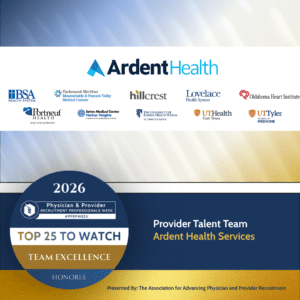
Ardent Health ServicesProvider Talent Team The Provider Talent Team at Ardent Health Services exemplifies what it means to operate as a unified, high-performing recruitment organization. This mission-driven group of Provider Talent Directors, recruiters, coordinators, and sourcing specialists works seamlessly as “One Team” under the leadership of Vice President Sarah McGee. In a short period of time, the team has achieved remarkable results, including a substantial increase in provider hires while significantly reducing reliance on external search firms. Their work reflects a strategic commitment to building strong internal recruitment capabilities while maintaining fiscal responsibility. The team also prioritizes professional development and collaboration. Members are supported in earning their CPRP credential, and the team regularly participates in recruitment events, conferences, and industry initiatives that advance the profession. Through innovative sourcing strategies, knowledge-sharing, and a culture of support, the Provider Talent Team continues to demonstrate the power of teamwork in advancing healthcare recruitment. |
|
|
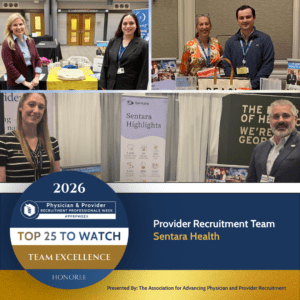
Sentara HealthProvider Recruitment Team The Provider Recruitment Team at Sentara Health demonstrated extraordinary resilience and collaboration during a period of significant organizational transition. Over the past year, the team navigated multiple complex challenges, including leadership transitions, the implementation of a new ATS, and a large-scale provider conversion—all while managing the recruitment of more than 100 critical provider hires and locums under demanding timelines. Rather than slowing down, the team mobilized. They established standardized workflows, developed new operating procedures, and strengthened collaboration with clinical and operational leaders. Their ability to maintain momentum during uncertainty reflects a strong culture of accountability, innovation, and shared ownership. Today, the Sentara Provider Recruitment Team stands as an example of what a dedicated and adaptable recruitment team can accomplish—even in the face of significant challenges. |
|
|
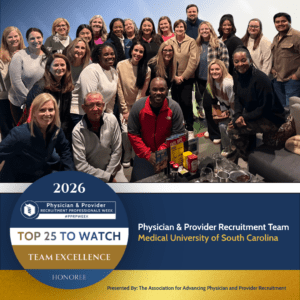
Medical University of South Carolina (MUSC)Physician & Provider Recruitment Team The Physician & Provider Recruitment Team at the Medical University of South Carolina (MUSC) has played a critical role in supporting the organization’s ambitious mission to expand access to healthcare across the state. Over the past six years, this collaborative team has successfully recruited more than 1,000 physicians and advanced practice providers to the MUSC system. Their efforts have helped extend specialty care, academic medicine, and essential services to communities throughout South Carolina. Composed of 32 professionals—including recruiters, onboarding specialists, sourcers, system administrators, and marketing experts—the team operates as a highly coordinated unit focused on delivering an exceptional candidate experience from first outreach through onboarding. Beyond their impressive results, the team is known for its strong culture of collaboration, professionalism, and dedication to MUSC’s mission. Their work continues to strengthen healthcare access for patients across the state. |
|
|
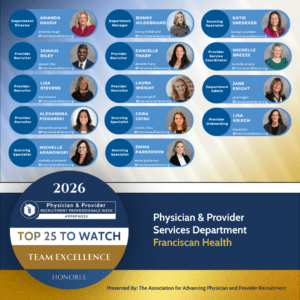
Franciscan HealthPhysician & Provider Services Department The Physician & Provider Services Department at Franciscan Health demonstrates the power of collaboration, innovation, and strategic recruitment practices. This fully integrated recruitment team supports more than 400 searches annually, resulting in hundreds of physician and advanced practice provider hires across four regions in Indiana and Illinois. The team includes provider liaisons, sourcing specialists, legal and onboarding professionals, and administrative support staff who work together to manage the full recruitment lifecycle. One of the department’s most significant achievements was the redesign of its recruitment strategy to build a strong internal sourcing function, eliminating reliance on third-party search firms. This shift reduced costs, improved time-to-fill, and strengthened alignment with Franciscan Health’s mission and values. Through strong partnerships with physicians, operational leaders, and system leadership, the team continues to deliver innovative recruitment solutions that support long-term workforce needs. |
|
|
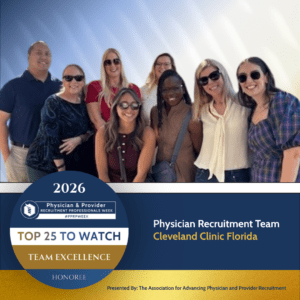
Cleveland Clinic FloridaPhysician Recruitment Team The Cleveland Clinic Florida Physician Recruitment Team demonstrates how a small, highly collaborative team can drive significant recruitment success across a large healthcare network. Despite its modest size, the team supports recruitment across five hospitals and more than 30 outpatient centers along Florida’s southeast coast. Through a well-structured recruitment model, each team member contributes specialized expertise while working together to provide seamless support for candidates and hiring leaders. Recruiters manage both site-specific responsibilities and specialty-aligned recruitment strategies, partnering closely with institute leadership to build targeted pipelines and recruitment plans. Their dedicated sourcer plays a key role in proactive outreach and candidate screening, ensuring a steady flow of qualified candidates. In 2026 alone, the team successfully recruited more than 125 physicians, helping support continued clinical expansion and improved patient access to care throughout the region. Through trust, collaboration, and shared accountability, the Cleveland Clinic Florida Physician Recruitment Team continues to deliver exceptional results while strengthening healthcare for the communities they serve. |
Each year, Physician and Provider Recruitment Professionals (PPRP) Week serves as an opportunity to recognize and elevate the critical work done by recruitment professionals across the healthcare industry.
Strong leadership is essential in physician and provider recruitment. Leaders in this field help guide teams, strengthen partnerships with healthcare organizations, and create environments where recruitment professionals can succeed.
The Inspiring Leader category spotlights individuals who lead with vision, integrity, and a commitment to excellence in physician and provider recruitment. Their leadership inspires others while advancing the profession as a whole.
Below are the professionals recognized in the Inspiring Leader category as part of the 2026 Top 25 Physician and Provider Recruitment Professionals to Watch.
|
|
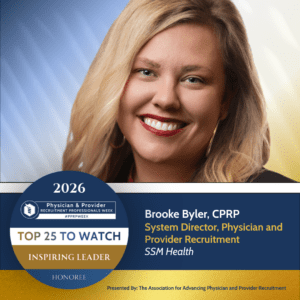
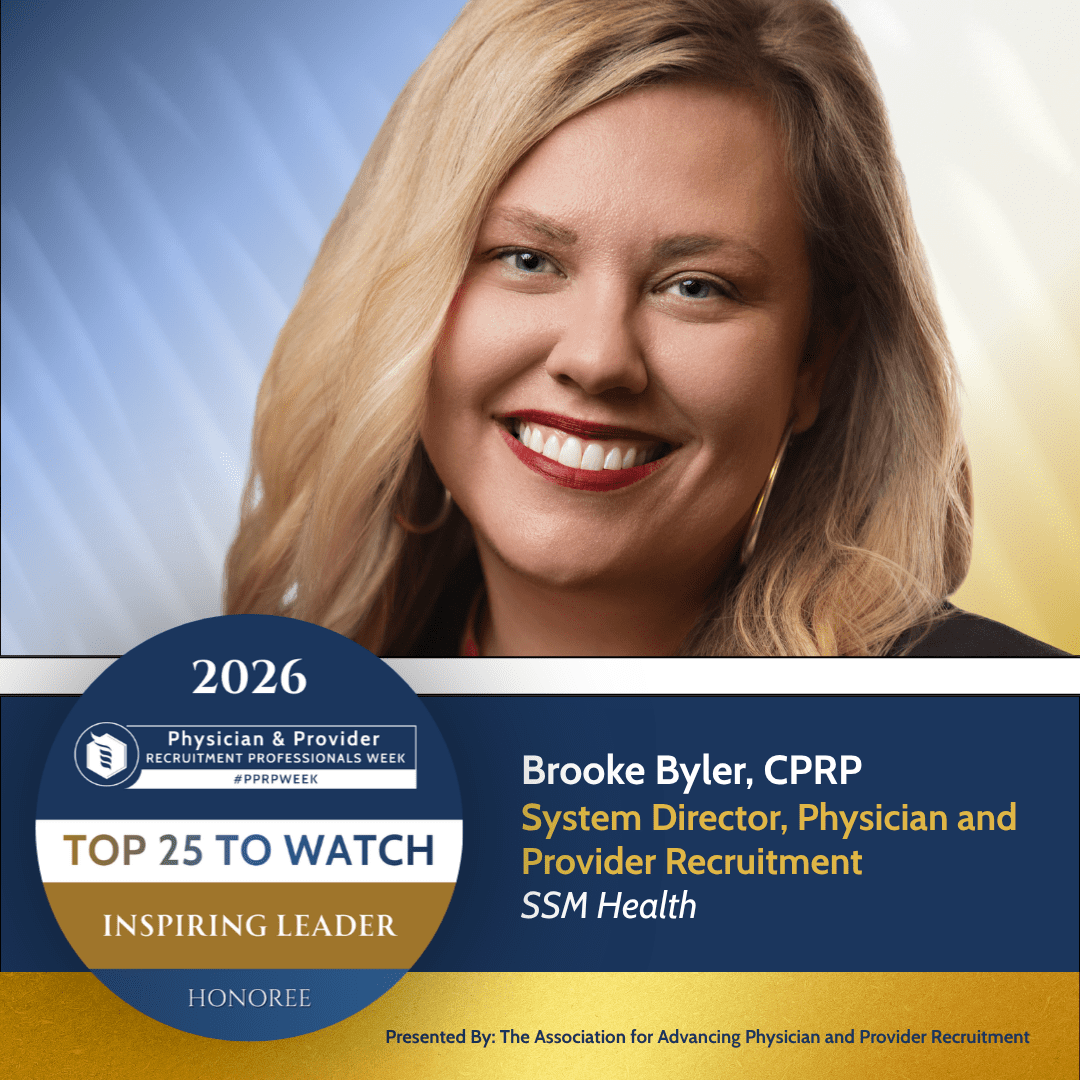
Brooke Byler, CPRPSystem Director, Physician and Provider Recruitment | SSM Health Brooke Byler is recognized as an Inspiring Leader for her exceptional leadership of a physician and provider recruitment team that spans four states within SSM Health. Since stepping into her role as System Director, Brooke has demonstrated a calm, thoughtful leadership style that prioritizes both people and results. She brings a steady presence to her team, ensuring that recruitment professionals feel supported while continuing to deliver strong outcomes for the organization. Her genuine care for her team and dedication to the profession have made her a trusted leader and role model for those around her. |
|
|
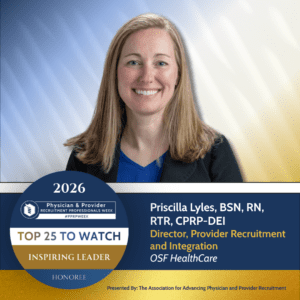
Priscilla Lyles, BSN, RN, RTR, CPRP-DEIDirector, Provider Recruitment and Integration | OSF HealthCare With more than 20 years of service to OSF HealthCare, Priscilla Lyles exemplifies leadership defined by compassion, authenticity, and a deep commitment to professional excellence. As Director of Provider Recruitment and Integration, Priscilla has cultivated a culture where team members feel valued, supported, and empowered to succeed. She actively encourages collaboration and ensures that every team member’s voice is heard in decision-making processes. Holding certifications including CPRP-DEI and OAR, Priscilla continuously invests in professional growth and inclusive leadership. Her impact extends beyond her organization through her role as Chair of ISPR, where she continues to advance the recruitment profession nationwide. |
|
|
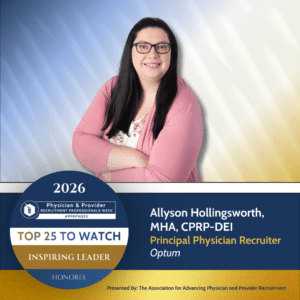
Allyson Hollingsworth, MHA, CPRP-DEIPrincipal Physician Recruiter | Optum Allyson Hollingsworth exemplifies excellence in physician and provider recruitment and serves as a strong ambassador for the profession. As a Principal Physician and Provider Recruiter at Optum, Allyson is known for building trusted relationships with hiring leaders and delivering recruitment strategies that improve both efficiency and the candidate experience. Her thoughtful, forward-looking approach to recruitment process improvement has made her a respected advisor within her organization. In addition to her professional contributions, Allyson is actively involved in AAPPR leadership, serving in local leadership roles and currently as a board member. Her dedication to advancing recruitment practices and supporting the broader recruitment community makes her an inspiring leader in the field. |
|
|
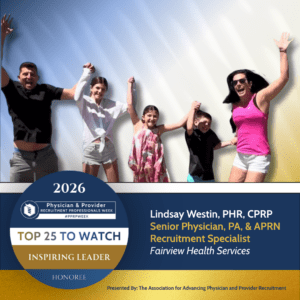
Lindsay Westin, PHR, CPRPSenior Physician, PA, & APRN Recruitment Specialist | Fairview Health Services Lindsay Westin is widely recognized by colleagues for the compassion, collaboration, and integrity she brings to physician and provider recruitment. Known for her ability to truly listen and understand the needs of both candidates and hiring leaders, Lindsay consistently creates meaningful connections that build trust and strengthen recruitment outcomes. Her collaborative approach ensures that teams work together to achieve the best possible results. Colleagues describe Lindsay as someone who elevates everyone around her. Her empathy, dedication to candidates, and willingness to support others make her an invaluable member of her team and a respected leader in the profession. |
|
|
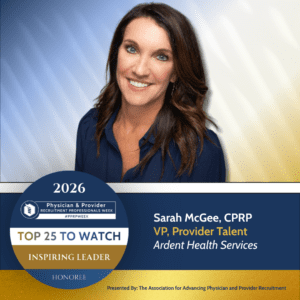
Sarah McGee, CPRPVice President, Provider Talent | Ardent Health Services Sarah McGee is recognized as an inspiring leader for the transformational impact she has had on the Provider Talent team at Ardent Health Services. Throughout her career, Sarah has demonstrated an unwavering commitment to excellence and a passion for developing strong recruitment teams. As Vice President of Provider Talent, she championed the creation of a “One Team” culture, strengthening collaboration across departments and improving alignment with organizational leadership. Her leadership has helped drive record-breaking outcomes for the organization while fostering a supportive and empowering environment for her team. Known for her accessibility, dedication, and people-first leadership style, Sarah continues to inspire those around her to grow, collaborate, and deliver exceptional results. |

Each year, Physician and Provider Recruitment Professionals (PPRP) Week serves as an opportunity to recognize and elevate the critical work done by recruitment professionals across the healthcare industry.
Every profession benefits from emerging leaders who bring energy, fresh perspectives, and a passion for making an impact. In physician and provider recruitment, these professionals are already demonstrating strong performance and leadership potential early in their careers.
The Rising Star category highlights emerging recruitment professionals who are early in their careers but already making a meaningful impact within their organizations and communities.
Below are the professionals recognized in the Rising Star category as part of the 2026 Top 25 Physician and Provider Recruitment Professionals to Watch.
|
|
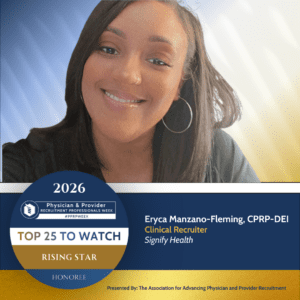
Eryca Manzano-Fleming, CPRP-DEIClinical Recruiter | Signify Health Eryca Manzano-Fleming embodies the mission of transforming healthcare one candidate at a time. As a Clinical Recruiter at Signify Health, she combines strong technical expertise across recruitment platforms with a thoughtful, human-centered approach to building healthcare teams. Holding her CPRP-DEI certification, Eryca brings a deep commitment to diversity, equity, and inclusion in every aspect of her work. Her ability to blend technology, strategy, and relationship-building allows her to identify and attract providers who strengthen healthcare organizations and improve patient access to care. Through her dedication to inclusive recruitment practices and continuous professional growth, Eryca represents the future of physician and provider recruitment. |
|
|
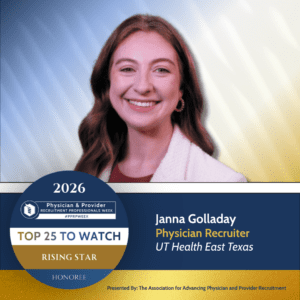
Janna GolladayPhysician Recruiter | UT Health East Texas Janna Golladay has quickly made a meaningful impact in physician and advanced practice provider recruitment at UT Health East Texas. Known for her strong work ethic and collaborative spirit, she approaches each search with enthusiasm and a commitment to supporting both candidates and her organization’s clinical teams. Janna has demonstrated an exceptional ability to build relationships with providers while helping guide them through the recruitment process. Her attention to detail and dedication to delivering a positive candidate experience have strengthened recruitment outcomes for her team. Her contributions to advanced practice provider recruitment have already made a noticeable difference, and her passion for the work continues to inspire those around her. |
|
|
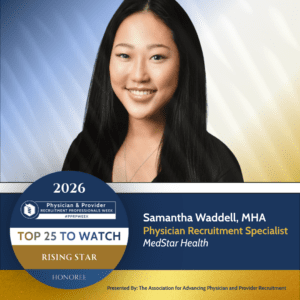
Samantha Waddell, MHAPhysician Recruitment Specialist | MedStar Health Samantha Waddell has emerged as a key contributor within the physician recruitment team at MedStar Health. As her team navigated the implementation of a new ATS and CRM, Samantha stepped forward proactively to deepen her understanding of the systems and provide valuable support to colleagues. Her exceptional talent for data analysis and reporting plays an important role in supporting departmental metrics and operational insights. Beyond her technical skills, Samantha is widely respected for her ability to build strong, authentic relationships with physicians and leadership across the organization. Having progressed from coordinator to physician recruitment specialist, Samantha demonstrates the dedication, initiative, and leadership potential that define a true Rising Star in the recruitment profession. |
|
|
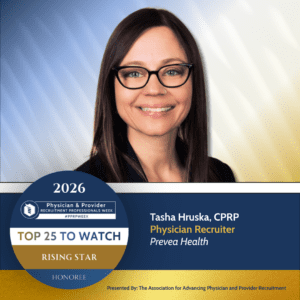
Tasha Hruska, CPRPPhysician Recruiter | Prevea Health Tasha Hruska has quickly distinguished herself as a rising leader within the physician recruitment team at Prevea Health. After nearly a decade with the organization in various roles, she transitioned into the recruiter position in 2023 and has already made an exceptional impact. In a short time, Tasha earned her CPRP certification, took on a leadership role as chair of the events committee for her local WSPR chapter, and excelled as a full-cycle recruiter. Her ability to build trusted relationships with physicians and clinical leaders has made her a valued partner throughout the recruitment process. Candidates consistently highlight her professionalism, responsiveness, and support throughout their recruitment experience—testament to the care and dedication she brings to her work every day. |
|
|
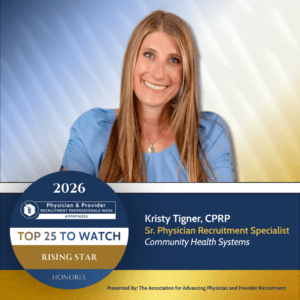
Kristy Tigner, CPRPSenior Physician Recruitment Specialist | Community Health Systems Kristy Tigner is an emerging professional whose leadership and strategic mindset are already making a lasting impact. She approaches recruitment with clarity, intention, and a commitment to advancing long-term workforce solutions. Kristy has played an important role in strengthening the cardiology physician pipeline for Community Health Systems. Her ability to balance big-picture strategy with the day-to-day demands of recruitment has helped drive momentum and accountability across her team. Known for her authenticity, collaboration, and dedication to excellence, Kristy consistently demonstrates that leadership is defined not by title, but by action and influence. Her trajectory points to a strong future as a leader in physician and provider recruitment. |
Each year, Physician and Provider Recruitment Professionals (PPRP) Week serves as an opportunity to recognize and elevate the critical work done by recruitment professionals across the healthcare industry.
Mentorship plays a critical role in strengthening the physician and provider recruitment profession. Experienced professionals who share their knowledge, guidance, and encouragement help cultivate the next generation of recruitment leaders.
The Mentor category celebrates professionals who are committed to guiding, supporting, and developing others in the recruitment field. Through their generosity, leadership, and willingness to invest in others, these individuals help elevate the entire profession.
Below are the professionals recognized in the Mentor category as part of the 2026 Top 25 Physician and Provider Recruitment Professionals to Watch.
|
|
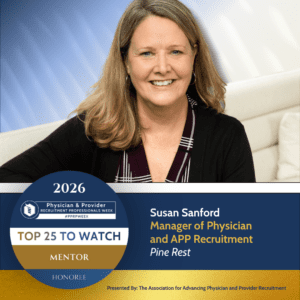
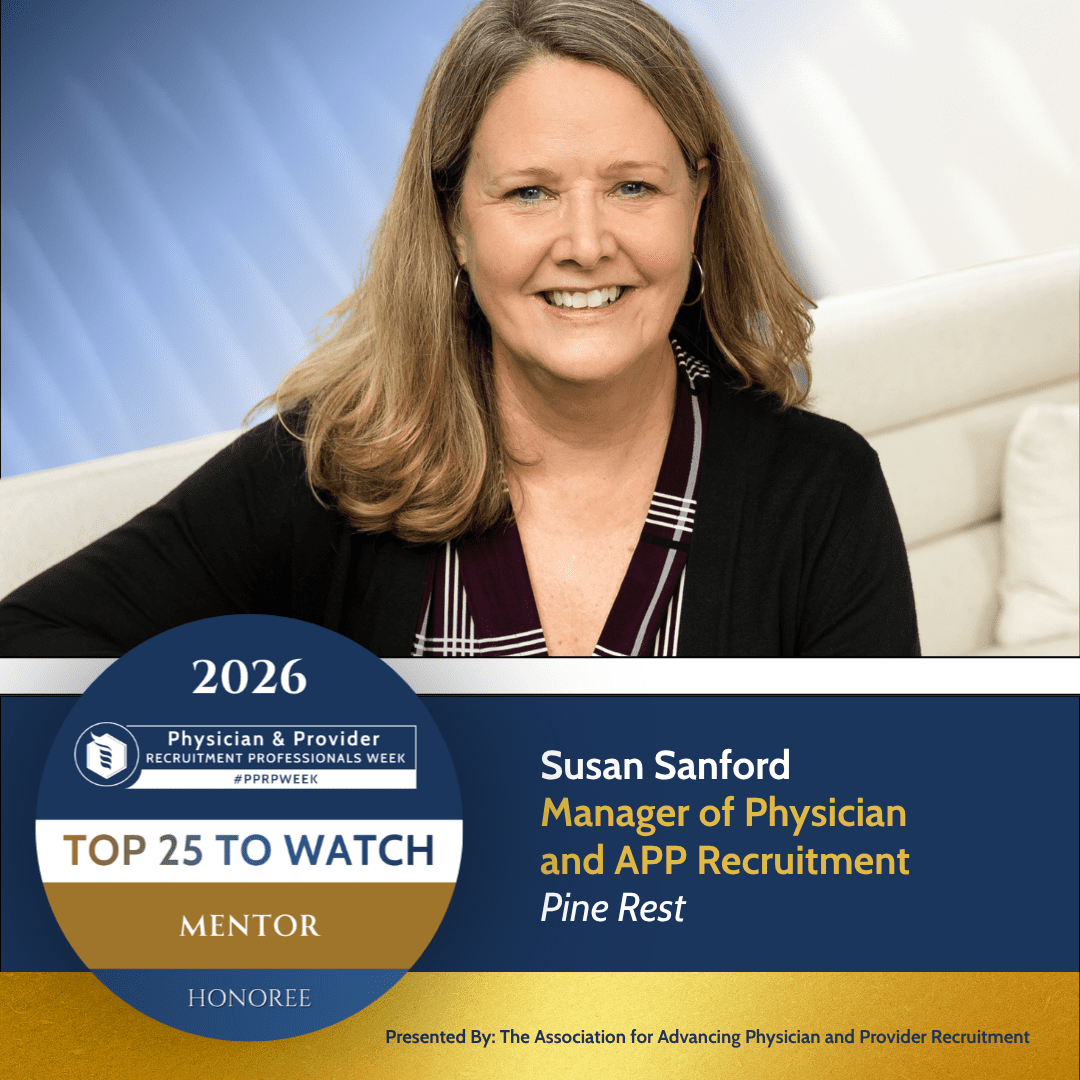
Susan SanfordManager of Physician & APP Recruitment | Pine Rest Join us in celebrating Susan Sanford, recognized as part of AAPPR’s Top 25 Physician and Provider Recruitment Professionals to Watch in the Mentor category. Susan has been a guiding force in the physician recruitment community for many years. Known for her willingness to share knowledge and support others, she has helped countless professionals grow in their careers. Her mentorship, leadership, and commitment to the profession continue to shape the next generation of recruitment professionals. |
|
|
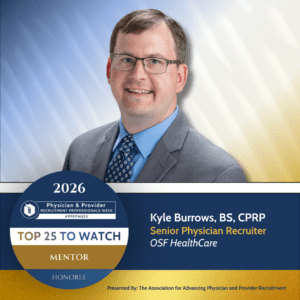
Kyle Burrows, BS, CPRPSenior Physician Recruiter | OSF HealthCare Join us in celebrating Kyle Burrows, BS, CPRP, recognized as part of AAPPR’s Top 25 Physician and Provider Recruitment Professionals to Watch in the Mentor category. Kyle is known for consistently supporting and mentoring colleagues while balancing the demands of a busy recruitment role. He generously shares his expertise, particularly during times of organizational change and integration. His approachable leadership style and dedication to helping others succeed make him a valued mentor and trusted resource. |
|
|
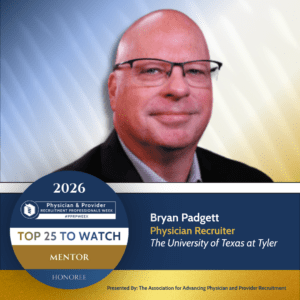
Bryan PadgettPhysician Recruiter | University of Texas at Tyler Join us in celebrating Bryan Padgett, recognized as part of AAPPR’s Top 25 Physician and Provider Recruitment Professionals to Watch in the Mentor category. Bryan brings deep expertise and a collaborative spirit to his work in physician recruitment. Colleagues appreciate his willingness to share ideas, brainstorm solutions, and support team success. His dedication and positive influence make him an important mentor within his organization. |
|
|
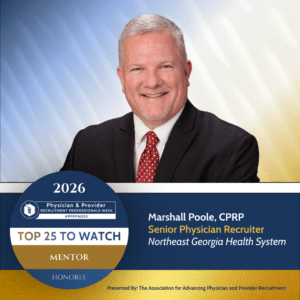
Marshall Poole, CPRPSenior Physician Recruiter | Northeast Georgia Health System Join us in celebrating Marshall Poole, CPRP, recognized as part of AAPPR’s Top 25 Physician and Provider Recruitment Professionals to Watch in the Mentor category. Marshall recently celebrated an incredible milestone—his 500th provider hire. Beyond the numbers, his work has expanded access to care for communities across the region. Through his service with the Southeast Physicians Recruiters Association and his commitment to mentoring colleagues, Marshall continues to elevate the recruitment profession. |
|
|
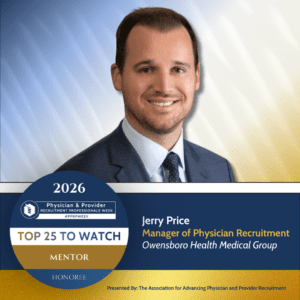
Jerry PriceManager of Physician Recruitment | Owensboro Health Medical Group Join us in celebrating Jerry Price, recognized as part of AAPPR’s Top 25 Physician and Provider Recruitment Professionals to Watch in the Mentor category. Jerry is known for his calm leadership style and dedication to helping others grow in the field of physician recruitment. He has played a pivotal role in mentoring colleagues transitioning into recruitment roles and ensuring they feel confident and supported. His guidance and encouragement have helped shape successful careers and strengthen recruitment teams. |

Each year, Physician and Provider Recruitment Professionals (PPRP) Week serves as an opportunity to recognize and elevate the critical work done by recruitment professionals across the healthcare industry.
Innovation drives the future of physician and provider recruitment. As healthcare continues to evolve, recruitment professionals must develop creative strategies, leverage new technologies, and rethink traditional approaches to attract and retain top clinical talent.
The Innovator category recognizes recruitment professionals who bring new ideas, creative strategies, and forward-thinking approaches to physician and provider recruitment. These individuals are not afraid to challenge the status quo and are helping their organizations and the profession move forward.
Below are the professionals recognized in the Innovator category as part of the 2026 Top 25 Physician and Provider Recruitment Professionals to Watch.
|
|
Abigail Holland, CPRPProvider Recruitment Partner | Trinity Health Join us in celebrating Abigail Holland, CPRP, recognized as part of AAPPR’s Top 25 Physician and Provider Recruitment Professionals to Watch in the Innovator category. Abigail consistently demonstrates excellence in physician and provider recruitment through her professionalism, attention to detail, and strong relationship-building skills. She approaches every search with a candidate-first mindset while balancing the needs of physicians, leaders, and the communities they serve. Her dedication, collaboration, and ability to navigate a competitive recruitment environment make a meaningful impact on her organization and the profession. |
|
|
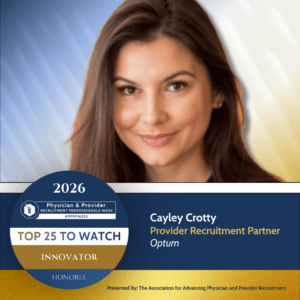
Cayley CrottyPrincipal Provider Recruiter | Optum Join us in celebrating Cayley Crotty, recognized as part of AAPPR’s Top 25 Physician and Provider Recruitment Professionals to Watch in the Innovator category. Cayley leads with curiosity and a genuine desire to improve experiences for both colleagues and candidates. Through peer-led employee listening sessions and thoughtful adoption of tools like AI, she has created meaningful improvements in collaboration, efficiency, and recruitment processes. Her creativity, generosity in sharing knowledge, and commitment to innovation make her a standout professional in physician and provider recruitment. |
|
|
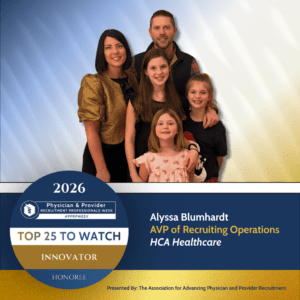
Alyssa BlumhardtAVP of Recruiting Operations | HCA Healthcare Join us in celebrating Alyssa Blumhardt, recognized as part of AAPPR’s Top 25 Physician and Provider Recruitment Professionals to Watch in the Innovator category. Alyssa has helped transform how strategy, technology, and operations work together in physician and provider recruitment. Her leadership has driven major improvements in data reporting, recruitment workflows, sourcing strategies, and enterprise recruitment systems. By building scalable, data-driven infrastructure that supports organizational growth and improved patient access to care, Alyssa has set a new standard for recruitment innovation. |
|
|
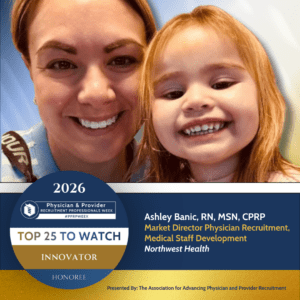
Ashley Banic, RN, MSN, CPRPMarket Director Physician Recruitment | Northwest Health Join us in celebrating Ashley Banic, RN, MSN, CPRP, recognized as part of AAPPR’s Top 25 Physician and Provider Recruitment Professionals to Watch in the Innovator category. Ashley brings creativity, strategic insight, and forward-thinking recruitment approaches to physician and provider recruitment. She has a unique ability to reimagine traditional strategies while building meaningful relationships with candidates and leadership partners. Her professionalism, passion, and commitment to long-term recruitment success make her a standout leader in the field. |
|
|
Shawna Roach, MHA, CPRPEnterprise Manager – Clinician Sourcing | Pediatric Associates Join us in celebrating Shawna Roach, MHA, CPRP, recognized as part of AAPPR’s Top 25 Physician and Provider Recruitment Professionals to Watch in the Innovator category. In a short time with Pediatric Associates, Shawna has brought tremendous value through creative sourcing strategies and a strong focus on measuring return on investment. As a working manager, she continually develops new ideas to help her team succeed. Her strategic thinking and innovative mindset are already making a significant impact on her organization’s recruitment efforts. |
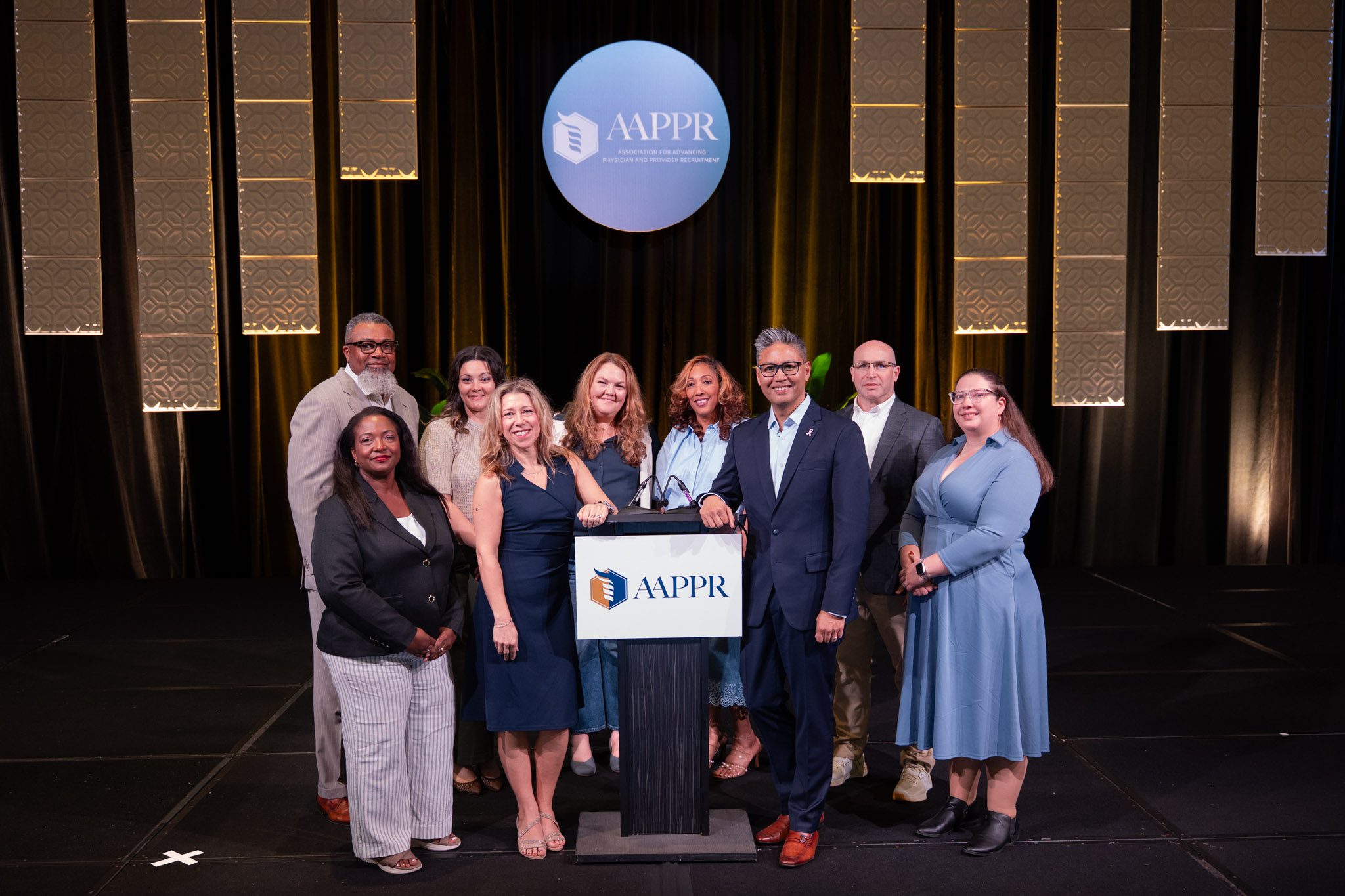
The Association for Advancing Physician and Provider Recruitment’s (AAPPR) is pleased to welcome three new board members, effective April 15, 2026. With their guidance, the organization will continue to bring innovative solutions and resources to advance the physician and provider recruitment profession. The 2026-2027 Board of Directors brings together a wealth of leadership and expertise that positions AAPPR for success.
Marcia Anderson, MHA, CPRP is a Physician Recruiter at WellSpan Health, where she supports full-scope physician and provider recruitment for a multi-facility health system dedicated to advancing community health across Central Pennsylvania.
With more than 25 years of experience in healthcare and over six years in comprehensive physician recruitment, Marcia brings a strategic blend of operational expertise, workforce planning, and mission-driven leadership. She is a Belonging Champion with a strong commitment to health equity. Her professional background is deeply rooted in women’s and children’s health, advocacy, and health equity, including extensive work addressing maternal and infant health disparities—particularly those impacting Black and Brown women. This perspective informs her approach to recruitment strategy, physician engagement, and sustainable workforce development.
Marcia earned a bachelor’s degree in business and a master’s degree in healthcare administration. She also holds the Registered Medical Manager (RMM) and Certified Physician Recruiter Professional (CPRP) credentials. She remains actively engaged in professional development, leadership, and community-centered initiatives. Selected for membership in the National Coalition of 100 Black Women in 2018, she remains an active member of Zeta Phi Beta Sorority, Incorporated and maintains professional memberships with Toastmasters International, MLAW, and the National Association of Parliamentarians. Throughout her service, she has held organizational leadership roles, chaired committees, and led fundraising, governance, and community-focused initiatives. She is also deeply engaged with AAPPR as a volunteer, mentor, presenter, and CPRP faculty member, contributing to education, micro-credentialing, and professional development within the physician recruitment community.
Marcia is adept at simplifying complex decision-making, strengthening bylaws and risk-management practices, and ensuring board and committee work aligns with mission and strategic priorities. Her combined expertise in physician recruitment, governance knowledge, advocacy experience, and commitment to health equity positions her to add disciplined, inclusive, and impact-focused leadership in board service.
Collin McKahin, MBA, CMSR, is the Director of Recruiting at Marvin Behavioral Health, a single-specialty organization that provides clinical mental health support to healthcare providers across the country. Previous to Marvin, Collin served with Tenet in CA; where he led physician, executive, and allied health recruitment across markets throughout the Central Valley of CA. Collin has also served as the Director of Business Development for Dignity Health (now part of CommonSpirit) in Sacramento and led many recruitment efforts into independent practices in the community and supported efforts with recruitment into the medical foundation for Dignity.
With 15 years of experience in healthcare recruitment, Collin is recognized for building creative, nontraditional pipelines and mentoring recruiters to grow into high-performing professionals who advance within their organizations. His work spans in-house and advisory roles, giving him a broad view of workforce dynamics, compensation variation, and the practical impact of organizational strategy on recruitment outcomes.
Collin has served on the Cristo Rey Board in Sacramento, supporting college-preparatory education for students of undocumented and low-income backgrounds, and has held advisory responsibilities for early-stage healthcare ventures focused on innovative care delivery. He is an active AAPPR contributor, speaking at national conferences, engaging in online forums, and sharing insights on recruiter development and clinician well-being.
Known as a long-term, systems-oriented thinker, Collin challenges assumptions, raises ethical considerations, and works across diverse stakeholder groups to solve complex problems. His experience navigating community boards, organizational politics, and emerging technologies such as AI equips him to bring practical, future-focused governance and candid, values-based perspective to board deliberations. Collin earned his Marketing Degree at Bradley University in Peoria IL, and his MBA at the University of Illinois, Springfield Campus.
Amber Williams, MPH, CPRP, serves as Director of Physician and Provider Recruitment at UNC Health, where she leads strategies to attract and retain clinical talent across a large, mission-driven academic health system.
With 11 years in the field and a Master of Public Health, Amber has built her career in recruitment from coordinator to director, gaining deep operational knowledge of how talent acquisition supports organizational performance and patient care. She is an active member of AAPPR, holds the CPRP certification, and contributes to course development and mentorship programs that elevate standards for in-house recruitment professionals.
Amber recently completed a two-year board term with Launch Holly Springs, where she also chaired the events committee and designed programs and engagement opportunities to support emerging small business leaders. She is a member of the American College of Healthcare Executives (TENC-NC chapter) and is known for her integrity, emotional intelligence, and ability to make thoughtful, future-focused decisions in complex environments.
Passionate about connecting people and advancing equity, Amber brings strengths in relationship-building, collaboration, and strategic thinking that translate directly to effective board service. She describes herself as a lifelong learner, resilient and patient leader, and authentic voice for operational perspectives in policy and strategic planning conversations.
As we welcome our new board members, President Allan Cacanindin shares his perspective on the future and continued growth of AAPPR.
Healthcare access begins long before a patient enters an exam room. It begins with courageous leaders willing to build the workforce of the future. These board members represent the very best of physician and provider recruitment — mission-driven professionals advancing innovation, culture, and access to care in communities across America.
At a time when healthcare organizations nationwide are facing historic workforce challenges, leaders like these remind us that physician and provider recruitment is not transactional work — it is strategic, human-centered leadership that directly shapes patient access, organizational stability, and the future of care delivery.
Behind every thriving health system is a workforce strategy strong enough to sustain it. The physician and provider recruitment profession has become one of healthcare’s most important strategic levers, and these leaders are helping guide that future with integrity, innovation, and purpose.
In every corner of the country, physician and provider recruitment leaders are helping determine whether patients receive timely access to care. That responsibility demands vision, resilience, and humanity. I’m proud to serve alongside leaders who are helping shape the future of healthcare workforce strategy nationwide.


Hear from AAPPR board members on why your experience matters and how participating in the compensation and search surveys helps create the benchmarking insight recruitment leaders need.
In physician and provider recruitment, leaders are being asked to make important decisions in an environment that continues to shift. Search timelines are changing, staffing needs remain high, compensation expectations are evolving and recruitment teams are being asked to show strategic value in ways that go beyond placements alone. That is why benchmarking data matters.
AAPPR’s Recruitment Team Compensation Survey and the Physician and Provider Search Survey help turn day-to-day recruitment experience into a clearer picture of what is happening across the field. The result is an annual Physician and Provider Recruitment Benchmarking Report to help leaders evaluate performance, compare trends and make more informed decisions about strategy, staffing and operations. But that insight is only as strong as the participation behind it.
The value of the report comes directly from the people who contribute to it – YOU! When recruitment leaders complete the surveys, they are not just reporting numbers – they are helping create the data leadership needs right now.

— Carol Sullivan, CPRP – AAPPR Board Member & Senior Director of Physician, Advanced Practice Provider, and Executive Physician Recruitment at Rochester Regional Health
Every organization that contributes helps create a more complete view of the physician and provider recruitment landscape. That matters because recruitment leaders need data that reflects real operational conditions, not assumptions.
When participation is strong, the benchmarking report becomes more meaningful for everyone. Leaders can better understand how their teams compare with peers, where market realities are shifting and what trends may be shaping recruitment performance across the country.
By contributing to the surveys, members help build a shared resource that strengthens decision-making across the profession.
— Allan Cacanindin CPRP, CDR – AAPPR Board President & Vice President of Physician, Advanced Practice Provider, and Executive Talent Acquisition at SSM Health
Participation does more than strengthen the report. It strengthens the quality of the decisions leaders can make with it.
Recruitment leaders are often asked to explain timelines, justify staffing models, evaluate sourcing strategies and advocate for team resources. Those conversations become more productive when they are grounded in credible, field-informed data. Benchmarking gives leaders the ability to move beyond isolated experience and see their work in the context of broader industry patterns.
That perspective helps organizations better understand what is realistic, what is competitive and where there may be opportunities to improve.
— Logan M. Ebbets, MS, CPRP – AAPPR Board Treasurer & Principal Recruiter at Signify Health
Metrics such as time-to-fill, recruiter productivity, candidate pipeline activity and recruiter capacity become far more useful when leaders can compare them against national benchmarks. That baseline helps organizations set more realistic expectations, especially for difficult searches and evolving market conditions.
It also helps leaders move conversations beyond anecdotal feedback and toward a clearer, more strategic understanding of performance.
— Fayeann Hauer, MHS, CPRP – AAPPR Board Member & Director of Physician and Provider Recruitment and Retention at Schneck Medical Center
Benchmarking data is not just useful for assessment. It is also essential for advocacy.
Recruitment leaders often need to make the case for staffing support, fair compensation and operational improvements that strengthen team performance. Objective benchmarking data helps validate those needs in a way that internal observations alone often cannot.
It also helps leaders identify areas where their teams may need additional support, whether that means adjusting workloads, refining processes or ensuring compensation aligns with the broader market.
— Doug Lewis, MS, CPRP – AAPPR Board Secretary & Vice President of Talent Acquisition at Sentara
When leaders have stronger data, they are better positioned to improve recruitment strategies, allocate resources more effectively and demonstrate the value of talent acquisition to executive leadership. Those improvements can strengthen recruitment infrastructure and help organizations remain competitive in attracting and retaining physician and provider talent.
In a field where strong recruitment directly affects workforce stability and patient access, that kind of clarity matters.
AAPPR’s benchmarking reports are valuable because they are built from the lived experience of physician and provider recruitment professionals. The more leaders who participate, the more useful, representative and actionable the data becomes.
If you have ever used data to explain a difficult search, advocate for more resources, assess compensation or evaluate team performance, you already understand why benchmarking matters. Participating in the Recruitment Team Compensation Survey and the Physician and Provider Search Survey is an opportunity to strengthen that resource for your organization and for the broader recruitment community.
Although the window to participate in the 2026 Recruitment Team Compensation Survey has closed, there is still time to participate in the 2026 Physician and Provider Recruitment Survey, closing May 19, 2026.
To learn more about the Benchmarking Report or view last year’s report, please visit our Benchmarking web page. Not a member, but want to be a part of this industry-changing report? Join now.

Congress is back in session after a two week recess with attention turning to a potential reconciliation bill to fund the Department of Homeland Security, and activity on the FY 2027 budget in full swing. As we celebrate Physician and Provider Recruitment Week, we want to take a moment to thank you for your hard work and dedication to upholding patient access.
AAPPR joined over 40 national medical associations and patient advocacy groups this month as cosigners of a coalition letter in support of H.R. 7961, the H-1Bs for Physicians and the Healthcare Workforce Act. The bipartisan legislation is in response to the Trump Administration’s September 2025 proclamation imposing a $100,000 fee on each new H-1B visa application, which is disproportionately harming the healthcare industry.
The H-1Bs for Physicians and the Healthcare Workforce Act would exempt physicians and other health professionals from the new $100,000 H-1B fee, ensuring employers can continue to fill critical access gaps. The legislation drew international attention, from the New York Times to the Times of India, highlighting the urgency around this issue. AAPPR thanks Reps. Mike Lawler (R-NY), Sanford D. Bishop, Jr. (D-GA), Maria Elvira Salazar (R-FL), and Yvette Clarke (D-NY) for their leadership on this issue.
New legislation impacting locum tenens was just introduced in the House. H.R. 8347, the “Reinforcing Underserved, Rural, and Local Healthcare Act” (the “RURAL Healthcare Act”), would create a clear federal rule that certain temporary locum tenens physicians and advanced care practitioners (meeting conditions including a written contract and a limit of no more than one continuous year at a single site) are treated as independent contractors, not employees, under federal pay-and-overtime laws and federal labor/union rules.
This proposal follows the “Health Care Provider Shortage Minimization Act” approach, which would amend the Internal Revenue Code to clarify that qualifying locum tenens physicians and advanced care practitioners are treated as independent contractors for federal tax purposes.
Taken together, the bills aim to provide clearer federal rules for when locum tenens clinicians can be treated as independent contractors.
AAPPR continues to partner with stakeholders across our federal priorities and will be sharing more resources on AAPPR’s website in the coming weeks. Be sure to take a look and let us know if you have any questions!


As the healthcare workforce landscape continues to evolve in 2026, in-house physician and provider recruitment professionals are carrying a larger load than ever. The demand for care remains high, yet the path to hiring and retaining clinicians has grown more complex. Last year brought new pressures from policy shifts, locums competition and compensation expectations, and it demanded more creativity and stamina from already stretched teams.
Candidates are in the driver’s seat and their expectations have shifted. Early-career physicians and advanced practice providers increasingly ask for four-day workweeks at full-time pay, part-time options and paid time off and candidates are willing to decline offers when their schedule preference can’t be accommodated.
More seasoned providers are putting greater emphasis on work-life balance and culture. Many are open to trading some compensation or additional shifts for more control over their schedules and more time away from clinical practice.
Across specialties, AAPPR members are seeing longer decision timelines, more extensive negotiations and more frequent use of attorneys to review contracts. Hard-to-recruit areas such as hospital medicine, women’s health, oncology, GI, urology, anesthesiology and radiology, remain under heavy pressure, particularly where locums rates far outpace compensation for permanent roles.
Policy and regulatory changes around loans, visas, graduate medical education and licensure continue to add complexity where these shifts could constrain the long-term pipeline, especially for candidates who rely on loans or immigration pathways.
With that in mind, success focuses less on filling every opening quickly and more on building a sustainable, resilient workforce strategy. That direction includes:
As recruitment challenges continue to evolve, organizations can shift from reactive hiring to more deliberate, long-term workforce planning. The strategies below highlight where focused effort can make the greatest impact.
Compensation models faced real pressure in 2025. Candidates often wanted larger up-front payments, longer guarantees and faster access to bonus funds. Some organizations attempted these changes and then reversed course after candidates withdrew or guarantees exceeded what volumes could support. The lesson is clear: recruitment leaders must explain total compensation, not just base salary or sign-on dollars, so candidates understand how guarantees, productivity, incentives and benefits fit together. It is important to set expectations about what happens after guarantees end, since short-term payouts can create long-term disappointment if productivity is not there.
With compensation becoming more competitive across markets, relationships are a key differentiator. Acceptance rates improve when leaders and potential colleagues engage early, when communication is timely and candid, and when candidates can picture daily life in the role. Inside organizations, sharing each signed contract with leaders can demonstrate recruitment’s strategic value and reinforce team morale.
The complexity of the current market makes internal alignment more important than ever. It costs time and revenue when recruiters juggle inconsistent and varied processes across the enterprise, when decisions are made without their input or when handoffs across teams are unclear. Bringing recruitment leaders into higher-level discussions can ensure plans reflect real market conditions, and consistent processes can reduce confusion for candidates and internal partners.
Teams that track more than days-to-fill are better equipped to drive change. Metrics on decision timelines, decline reasons and negotiation trends help recruitment leaders make stronger cases for updated compensation structures or garnering support for process improvements. When paired with external benchmarks, this data gives organizations a clearer, more realistic view of what to target today.
As organizations navigate the year ahead, this is a good time to review your internal processes, reconnect with your peers and use AAPPR’s research and resources to guide next steps. Together, we can help strengthen the recruitment profession and build a more resilient workforce.
Physician and provider recruitment is a profession built on relationships. Every search, every successful placement, and every retained provider begins with a connection. But while recruiters spend much of their time building relationships with candidates and organizations, one of the most valuable connections we can make is with each other.
The Association for Advancing Physician and Provider Recruitment (AAPPR) has created a community where recruiters are not competitors, but collaborators. Within this network, professionals share strategies, celebrate wins, troubleshoot challenges, and continuously push the profession forward. In a field that can often feel fast-paced and high-pressure, having a supportive network of peers who understand the complexities of recruitment is invaluable.
Networking with fellow AAPPR members has the power to strengthen recruitment strategies in ways that simply cannot be achieved alone. Conversations with peers often spark new ideas—whether it’s a creative approach to sourcing candidates, innovative onboarding practices, or retention strategies that support long-term workforce stability. Learning how others navigate rural recruitment challenges, specialty shortages, or evolving workforce expectations can immediately impact how we serve our organizations and communities.
Opportunities like the AAPPR Annual Conference and PPRP Week provide powerful spaces for these connections to flourish. The Annual Conference brings together recruitment professionals from across the country to share insights, explore new tools, and learn from industry leaders. The conversations in breakout sessions, hallway discussions, and networking events often become the ideas that transform recruitment programs back home.
Similarly, PPRP Week offers a chance to celebrate the work of physician and provider recruiters while highlighting the impact this profession has on healthcare access. It’s a moment to recognize that behind every provider hired is a recruiter working tirelessly to ensure communities receive the care they need.
Personally, this community has had a profound impact on my professional journey. In April of 2026, my six years of service on the AAPPR Board of Directors will come to an end. It has truly been an honor to serve an organization that has given so much to me and has played a meaningful role in shaping me as a recruitment professional. The mentors, colleagues, and friends I have gained through AAPPR have strengthened not only my work, but my passion for this field.
At its core, physician and provider recruitment is about building the healthcare workforce of tomorrow. Through connection, collaboration, and community, AAPPR ensures that none of us have to do that work alone.
AAPPR uses cookies for functional and analytical purposes. By continuing to browse or by clicking “Accept,” you agree to the storing of cookies on your device to enhance your site experience. To learn more about how we use cookies or how to change your settings, please see our privacy policy.
Accept Close