
Congress is about two weeks away from adjourning for its August recess, and lawmakers are hoping to address several outstanding items before leaving Washington. When they return in September, they will have less than a month in session before attention shifts again to the midterm elections. While there are some areas of bipartisanship, there are also points of intraparty tension, particularly between the House and Senate. The key question is whether Congress can come together to fund the government by September 30, likely through a continuing resolution that extends beyond the midterms and avoids another painful government shutdown.
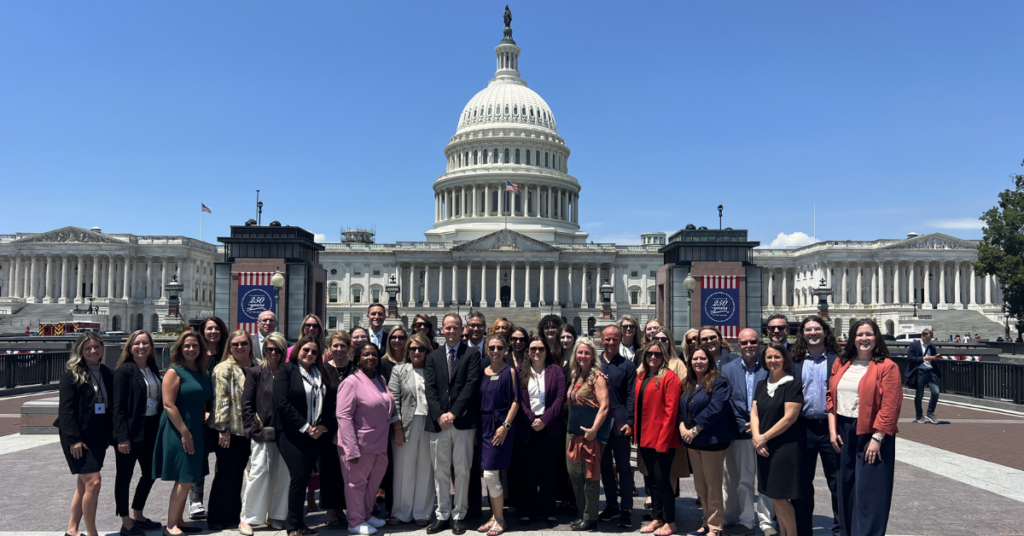
AAPPR Hosts First Fly-In in Washington DC
Last month, AAPPR leaders took to Capitol Hill to meet with lawmakers to discuss key issues impacting provider recruitment and retention. We met with over 50 congressional offices across the political spectrum to highlight four pieces of bipartisan legislation that would meaningful address many of the challenges faced by healthcare employers, providers, and importantly, patients. These included addressing Medicare reimbursement issues, investing in Graduate Medical Education (GME), exempting healthcare workers from the $100,000 H-1B fee, and reauthorizing the Conrad 30 program.
This was a great opportunity to raise awareness about physician recruitment and other provider issues, and to begin building relationships with offices where our members live and work. There will be more exciting opportunities like this in the future an we encourage you to get involved.
Bipartisan Legislation Introduced to Reform Medicare Payment
The bipartisan Patients First Act was introduced by Reps. John Joyce (R-OH), Greg Murphy (R-NC), and Kim Schrier (D-WA), the respective chairs of the Republican and Democratic Doctors Caucuses in Congress, as an effort to update Medicare physician payment policy and strengthen access to care. The bill is especially relevant because it addresses some of the financial and administrative pressures that can make it harder for physicians to remain in practice, particularly in independent, rural, and underserved settings.
The proposal would tie physician payment more closely to the cost of providing care, invest in primary care, simplify quality reporting, and support participation in value-based care models. AAPPR is closely reviewing the legislation and will follow up with more details and potential next steps.
Final J-1 Duration of Status Rule Released
The Trump Administration recently issued a final rule replacing the long-standing “duration of status” framework for certain visa holders, including J-1 exchange visitors, with fixed periods of admission and a formal extension process through federal immigration authorities. While the rule is framed by DHS as a way to increase oversight, medical and recruitment organizations have raised concerns about what it could mean for the physician workforce, especially for international medical graduates who train and practice in the United States.
From a recruitment and retention perspective, the concern is that new extension requirements during residency or fellowship could add uncertainty, paperwork, and possible interruptions in training or clinical service, making it harder for programs to attract and keep the physicians their patients rely on. AAPPR is reviewing the final rule and will follow up with additional information. Please reach out if you have any questions.