
Have a question?
Contact us
The Association for Advancing Physician and Provider Recruitment (AAPPR) is redefining recruitment to retention and is the only professional organization where physician and provider recruitment leaders and others who influence recruitment, onboarding and retention can connect, learn and advance their careers.
The Association for Advancing Physician and Provider Recruitment (AAPPR), the leading authority on physician recruitment, onboarding and retention, today announced its support for the Physician Workforce Optimization Act, bipartisan legislation introduced by Sen. Kevin Cramer (R-ND) and Sen. Amy Klobuchar (D-MN) to strengthen the Conrad 30 J-1 Visa Waiver Program and expand access to care in underserved communities.
The Conrad 30 Program allows states to request waivers of the two-year home residency requirement for J-1 visa physicians in exchange for at least three years of full-time service in health professional shortage areas. Each state receives up to 30 waivers annually, including flex waivers for physicians serving underserved patient populations outside designated shortage areas. However, states frequently exhaust their flex waiver allocations while other Conrad waiver slots remain unused, a structural imbalance that disproportionately affects smaller and rural states that depend on flex waivers to deliver care to their communities. Additionally, physicians who apply to states where waiver slots fill quickly have no structured pathway to connect with states that have unfilled slots.
The Physician Workforce Optimization Act addresses these challenges by increasing the number of flex waivers available to each state from 10 to 15 and establishing a national secondary physician match portal. The portal would allow physicians who were not selected or unable to apply in their preferred state to be matched with states that have unused waiver slots, improving physician placement efficiency in medically underserved areas.
“AAPPR strongly supports the Physician Workforce Optimization Act,” said Carey Goryl, AAPPR CEO. “By expanding flex waiver capacity and creating a structured secondary match portal, this legislation provides a practical solution for smaller states that have historically struggled to attract applicants or fully utilize their programs. AAPPR is committed to ensuring that every community has access to the physician workforce it needs, and this bill is a meaningful step toward strengthening healthcare access nationwide.”
AAPPR thanks Sen. Cramer and Sen. Klobuchar for their bipartisan leadership on this issue and looks forward to working with Congress to advance policies that strengthen physician recruitment and ensure every community can access the healthcare providers it needs.
For more information about AAPPR and its advocacy efforts, visit aappr.org/government-affairs/.
The Association for Advancing Physician and Provider Recruitment (AAPPR) is the mission-aligned authority on addressing clinical workforce shortages and expanding access to care. For more than 30 years, AAPPR has connected and supported physician and provider recruitment professionals who serve as strategic partners within hospitals and health systems nationwide. Today, AAPPR represents over 2,700 members. Fully integrated into their organizations, AAPPR members lead the full recruitment continuum, designing hiring, onboarding, and retention strategies that mitigate vacancy impacts and strengthen care delivery. Guided by our RECRUIT values – Respect, Equity, Collaboration, Responsibility, Understanding, Inclusion, and Trust – AAPPR and its members cultivate a diverse, data-informed workforce dedicated to ensuring equitable access to care. To learn more or to become an organizational member of AAPPR, please visit https://aappr.org/join-now.
Alexis Schuchert
Franco
aschuchert@franco.com
Alysia Gradney
AAPPR
agradney@aappr.org

We are thrilled to announce that Russ Peal, CPRP, CMSR, has been named President-Elect for the Association for Advancing Physician and Provider Recruitment (AAPPR) Board of Directors. This two-year appointed term, once complete, will transition to Board President for 2027 – 2028. Both he and the current Board President, Allan Cacanindin, CPRP-DEI, will work closely with the board, CEO and staff to ensure a strategic direction for the Association.
In his employed role, Russ is the Director of Workforce Recruitment and Retention for the Veterans Health Administration (VHA).
Russ Peal is the Director of Workforce Recruitment and Retention for the VHA, the largest integrated health care system in the US. In his role, Russ provides strategic direction and executive oversight for the agency’s national efforts to recruit, retain, and develop its most critical clinical occupations. He is credited with establishing VHA’s first in-house physician/provider recruitment operation and led the largest specialty recruitment and hiring initiative in its history. He has more than 30 years of direct experience in the profession – including both the public and private sectors.
Russ is a native Chicagoan, graduate of Eastern Illinois University, and a proud Air Force Veteran. He is a member of the American College of Healthcare Executives and an Excellence in Government Fellow with the Partnership for Public Service.
Please join us in congratulating Russ Peal on this remarkable achievement by connecting with him on LinkedIn at https://www.linkedin.com/in/russp/.
AAPPR is proud to announce Russ Peal as its incoming President-Elect. Current Board President Allan Cacanindin, CPRP, CDR, shared the following message on Russ’s leadership and impact:
“Russ Peal’s leadership reflects what is possible when workforce strategy is elevated to a national priority. His dedication to strengthening recruitment, retention, and clinician support across one of the nation’s largest healthcare systems continues to help advance conversations that impact veterans, communities, and healthcare organizations across America.”
Several health workforce pipeline issues are actively moving in both Congress and the Administration, even as Congressional Republicans focus on a reconciliation package addressing immigration and FY27 appropriations negotiations remain underway. With roughly six weeks of legislative session before the July 4th recess and a compressed calendar through November, the window to shape these measures and other issues requires sustained engagement.
Earlier this month, the Trump Administration quietly reversed policy permitting foreign doctors to receive visas to practice in the United States. A Department of Homeland Security policy stemming from a travel ban that was put in place in January had frozen decisions on visa extensions, work permits and green cards for citizens of 39 countries. Some physicians were subsequently placed on administrative leave by hospitals, and many others faced the imminent threat of being forced to stop working. Foreign physicians make up 25 percent of all doctors working in the United States, and more than 60 percent practice primary care.
While international medical graduates from the 39 affected countries should be able to move forward with visa processing, it may take a few weeks for the Administration to clear those backlogs. Please reach out if you are experiencing delays for impacted physicians or have any questions.
The Education Department issued a final rule last week that limits how much graduate students can borrow each year. Graduate nursing students will be capped at $20,500 annually, while medical students can access up to $50,000. The Grad PLUS program, which lets students borrow up to the full cost of attendance, ends in July.
Why this matters: Health systems are already facing shortages. Tighter borrowing limits may make it harder for future nurses, nurse practitioners, nurse anesthetists, and nurse midwives to pay for school, which could slow the pipeline, especially in rural and underserved areas. Recruiters should watch for enrollment shifts and consider whether scholarships, tuition support, or partnerships can help keep candidates on track. AAPPR will continue tracking the impact on the workforce in the months ahead.
Support is growing for the bipartisan H 1Bs for Physicians and the Healthcare Workforce Act (H.R. 7961), which would exempt physicians and other health professionals from the $100,000 H 1B filing fee. International medical graduates are often the backbone of care in rural and underserved communities, filling primary care and specialty gaps where recruitment is hardest. Slapping a $100,000 H 1B filing fee onto each new hire would strain hospital and practice budgets, leading to fewer hires, longer wait times, and deeper shortages for patients who already face limited access.
Reps. Mike Lawler (R NY), Sanford D. Bishop, Jr. (D GA), Maria Elvira Salazar (R FL), and Yvette Clarke (D NY) are leading the House effort, with a bipartisan Senate introduction expected soon.
Last week’s webinar gave a high-level walkthrough of the Big Beautiful Bill (BBB), its biggest Medicaid and care-delivery changes, key implementation timelines, and what healthcare recruiters need to know now. We covered how BBB will shape workforce needs and recruitment strategies over the next several years, with practical guidance to prepare organizations for these changes. You can view the webinar by clicking here.
The Association for Advancing Physician and Provider Recruitment (AAPPR), the leading authority on physician recruitment, onboarding and retention, joined over 40 national medical associations and patient advocacy groups this month as cosigners of a coalition letter in support of H.R. 7961, the H-1Bs for Physicians and the Healthcare Workforce Act. The bipartisan legislation is in response to the Trump Administration’s September 2025 proclamation imposing a $100,000 fee on each new H-1B visa application, which is disproportionately harming the healthcare industry.
The recruitment of physicians and other healthcare workers is a time- and resource-intensive process often spanning over a year for a single candidate. Healthcare employers recruit from a broad pool of candidates, including international medical graduates (IMG), since they are more likely to serve in rural and underserved areas.
The fee, increased by 1900% ,is causing employers to pause or move away from recruiting IMGs despite the urgent need and limited pool of available candidates, especially in fields like oncology, OB/GYN and nephrology, specialties with high days to fill, an AAPPR metric that measures the time from opening a physician search to securing a signed contract.
To address this, the H-1Bs for Physicians and the Healthcare Workforce Act would exempt physicians and other health professionals from the new $100,000 H-1B fee, ensuring employers can continue to fill critical access gaps. The legislation drew international attention, from the New York Times to the Times of India, highlighting the urgency around this issue. As the coalition letter notes, the bill ensures that “physicians and other essential health care providers are not unnecessarily swept into a fee structure designed to address other workforce sectors.”
“The $100,000 H-1B filing fee on health care entities poses a serious challenge to provider recruitment at a time when demand for physicians and other health care professionals continues to grow,” said Carey Goryl, CEO, Association for Advancing Physician and Provider Recruitment. “Hospitals, health systems and practices across the country rely on international physicians and health care professionals to meet patient needs. This fee could slow recruitment efforts and make it harder for employers to bring on the providers their communities depend on. AAPPR supports the H-1Bs for Physicians and the Healthcare Workforce Act and applauds Reps. Mike Lawler (R-NY), Sanford D. Bishop (D-GA), Maria Elvira Salazar (R-FL) and Yvette Clarke (D-NY) for their bipartisan leadership on this issue.”
As AAPPR and healthcare recruitment professionals celebrate Physician and Provider Recruitment Professionals Week, April 20-26, this legislation underscores the vital role recruitment professionals play in ensuring communities across the country have access to the healthcare providers they need.
For more information about AAPPR and its advocacy efforts, visit https://aappr.org/.
The Association for Advancing Physician and Provider Recruitment (AAPPR) is a nationally recognized leader in health care provider recruitment, onboarding, and retention. For more than 30 years, AAPPR has empowered physician and advanced practice provider recruitment leaders to transform care delivery in their communities by providing best-in-class practices, up-to-date industry knowledge, and evolving innovative approaches for hiring, onboarding, and retaining exceptional clinical talent. To learn more or to become an organizational member of AAPPR, please visit https://aappr.org/join-now.
Alexis Schuchert
Franco
aschuchert@franco.com
Alysia Gradney
AAPPR
agradney@aappr.org
Each year, Physician and Provider Recruitment Professionals (PPRP) Week serves as an opportunity to recognize and elevate the critical work done by recruitment professionals across the healthcare industry. From identifying and attracting top talent to guiding physicians and advanced practice providers through the hiring process and supporting long-term retention, these professionals help healthcare organizations build the clinical teams that communities depend on.
Physician and Provider Recruitment Professionals Week (PPRP Week), taking place April 20–26, 2026, is dedicated to recognizing the individuals and teams who make this work possible. Throughout the week, we encourage organizations, colleagues, and the broader healthcare community to celebrate recruitment, onboarding, and retention professionals who play a vital role in shaping the future of healthcare.
As part of this year’s celebration, AAPPR is proud to recognize the 2026 Top 25 Physician and Provider Recruitment Professionals to Watch. These individuals represent the next generation of leaders in the recruitment profession. Through their work, they are advancing the field, supporting their organizations, and helping shape the future of healthcare recruitment. Honorees are recognized across several categories:
Recruitment professionals introducing creative ideas and forward-thinking strategies.


Learn more about each honoree and the impact they are making in physician and provider recruitment.
Professionals dedicated to guiding and supporting others in the field
Learn more about each honoree and the impact they are making in physician and provider recruitment.
Emerging professionals making a strong impact early in their careers

Learn more about each honoree and the impact they are making in physician and provider recruitment.
Individuals who lead with vision, integrity, and a commitment to excellence

Learn more about each honoree and the impact they are making in physician and provider recruitment.
Meet the 2026 Inspiring Leaders
Recruitment teams demonstrating exceptional collaboration and results
Learn more about each honoree and the impact they are making in physician and provider recruitment.
Meet the 2026 Team Excellence Honorees
PPRP Week is a time for the entire recruitment community to come together and recognize the professionals who help healthcare organizations grow and thrive. Share a photo of yourself, your team, or your organization celebrating PPRP Week, and help us highlight the incredible work happening across the recruitment profession.
Use your graphic to celebrate the week and help raise awareness about the important work recruitment professionals do every day.

One of the best ways to celebrate PPRP Week is by sharing the people and teams who make a difference in physician and provider recruitment.

Each year, Physician and Provider Recruitment Professionals (PPRP) Week serves as an opportunity to recognize and elevate the critical work done by recruitment professionals across the healthcare industry.
Successful recruitment is rarely the work of one individual. Behind every successful hire is often a collaborative team working together to source candidates, coordinate interviews, manage onboarding, and support long-term success.
The Team Excellence category highlights recruitment teams that demonstrate outstanding collaboration, innovation, and results. These teams work together to overcome challenges, support their organizations, and strengthen healthcare systems.
Below are the teams recognized in the Team Excellence category as part of the 2026 Top 25 Physician and Provider Recruitment Professionals to Watch.
|
|
Ardent Health ServicesProvider Talent Team The Provider Talent Team at Ardent Health Services exemplifies what it means to operate as a unified, high-performing recruitment organization. This mission-driven group of Provider Talent Directors, recruiters, coordinators, and sourcing specialists works seamlessly as “One Team” under the leadership of Vice President Sarah McGee. In a short period of time, the team has achieved remarkable results, including a substantial increase in provider hires while significantly reducing reliance on external search firms. Their work reflects a strategic commitment to building strong internal recruitment capabilities while maintaining fiscal responsibility. The team also prioritizes professional development and collaboration. Members are supported in earning their CPRP credential, and the team regularly participates in recruitment events, conferences, and industry initiatives that advance the profession. Through innovative sourcing strategies, knowledge-sharing, and a culture of support, the Provider Talent Team continues to demonstrate the power of teamwork in advancing healthcare recruitment. |
|
|
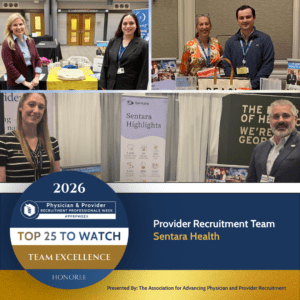
Sentara HealthProvider Recruitment Team The Provider Recruitment Team at Sentara Health demonstrated extraordinary resilience and collaboration during a period of significant organizational transition. Over the past year, the team navigated multiple complex challenges, including leadership transitions, the implementation of a new ATS, and a large-scale provider conversion—all while managing the recruitment of more than 100 critical provider hires and locums under demanding timelines. Rather than slowing down, the team mobilized. They established standardized workflows, developed new operating procedures, and strengthened collaboration with clinical and operational leaders. Their ability to maintain momentum during uncertainty reflects a strong culture of accountability, innovation, and shared ownership. Today, the Sentara Provider Recruitment Team stands as an example of what a dedicated and adaptable recruitment team can accomplish—even in the face of significant challenges. |
|
|
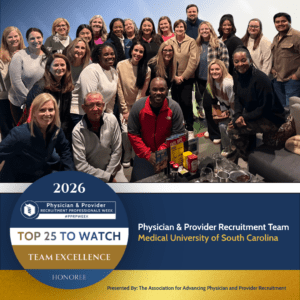
Medical University of South Carolina (MUSC)Physician & Provider Recruitment Team The Physician & Provider Recruitment Team at the Medical University of South Carolina (MUSC) has played a critical role in supporting the organization’s ambitious mission to expand access to healthcare across the state. Over the past six years, this collaborative team has successfully recruited more than 1,000 physicians and advanced practice providers to the MUSC system. Their efforts have helped extend specialty care, academic medicine, and essential services to communities throughout South Carolina. Composed of 32 professionals—including recruiters, onboarding specialists, sourcers, system administrators, and marketing experts—the team operates as a highly coordinated unit focused on delivering an exceptional candidate experience from first outreach through onboarding. Beyond their impressive results, the team is known for its strong culture of collaboration, professionalism, and dedication to MUSC’s mission. Their work continues to strengthen healthcare access for patients across the state. |
|
|
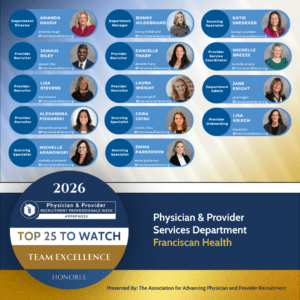
Franciscan HealthPhysician & Provider Services Department The Physician & Provider Services Department at Franciscan Health demonstrates the power of collaboration, innovation, and strategic recruitment practices. This fully integrated recruitment team supports more than 400 searches annually, resulting in hundreds of physician and advanced practice provider hires across four regions in Indiana and Illinois. The team includes provider liaisons, sourcing specialists, legal and onboarding professionals, and administrative support staff who work together to manage the full recruitment lifecycle. One of the department’s most significant achievements was the redesign of its recruitment strategy to build a strong internal sourcing function, eliminating reliance on third-party search firms. This shift reduced costs, improved time-to-fill, and strengthened alignment with Franciscan Health’s mission and values. Through strong partnerships with physicians, operational leaders, and system leadership, the team continues to deliver innovative recruitment solutions that support long-term workforce needs. |
|
|
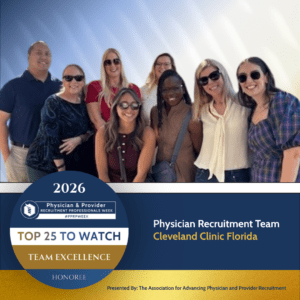
Cleveland Clinic FloridaPhysician Recruitment Team The Cleveland Clinic Florida Physician Recruitment Team demonstrates how a small, highly collaborative team can drive significant recruitment success across a large healthcare network. Despite its modest size, the team supports recruitment across five hospitals and more than 30 outpatient centers along Florida’s southeast coast. Through a well-structured recruitment model, each team member contributes specialized expertise while working together to provide seamless support for candidates and hiring leaders. Recruiters manage both site-specific responsibilities and specialty-aligned recruitment strategies, partnering closely with institute leadership to build targeted pipelines and recruitment plans. Their dedicated sourcer plays a key role in proactive outreach and candidate screening, ensuring a steady flow of qualified candidates. In 2026 alone, the team successfully recruited more than 125 physicians, helping support continued clinical expansion and improved patient access to care throughout the region. Through trust, collaboration, and shared accountability, the Cleveland Clinic Florida Physician Recruitment Team continues to deliver exceptional results while strengthening healthcare for the communities they serve. |
Each year, Physician and Provider Recruitment Professionals (PPRP) Week serves as an opportunity to recognize and elevate the critical work done by recruitment professionals across the healthcare industry.
Strong leadership is essential in physician and provider recruitment. Leaders in this field help guide teams, strengthen partnerships with healthcare organizations, and create environments where recruitment professionals can succeed.
The Inspiring Leader category spotlights individuals who lead with vision, integrity, and a commitment to excellence in physician and provider recruitment. Their leadership inspires others while advancing the profession as a whole.
Below are the professionals recognized in the Inspiring Leader category as part of the 2026 Top 25 Physician and Provider Recruitment Professionals to Watch.
|
|
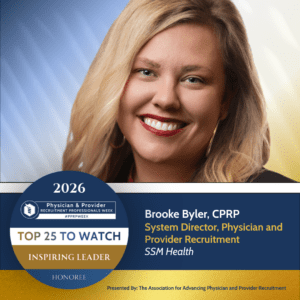
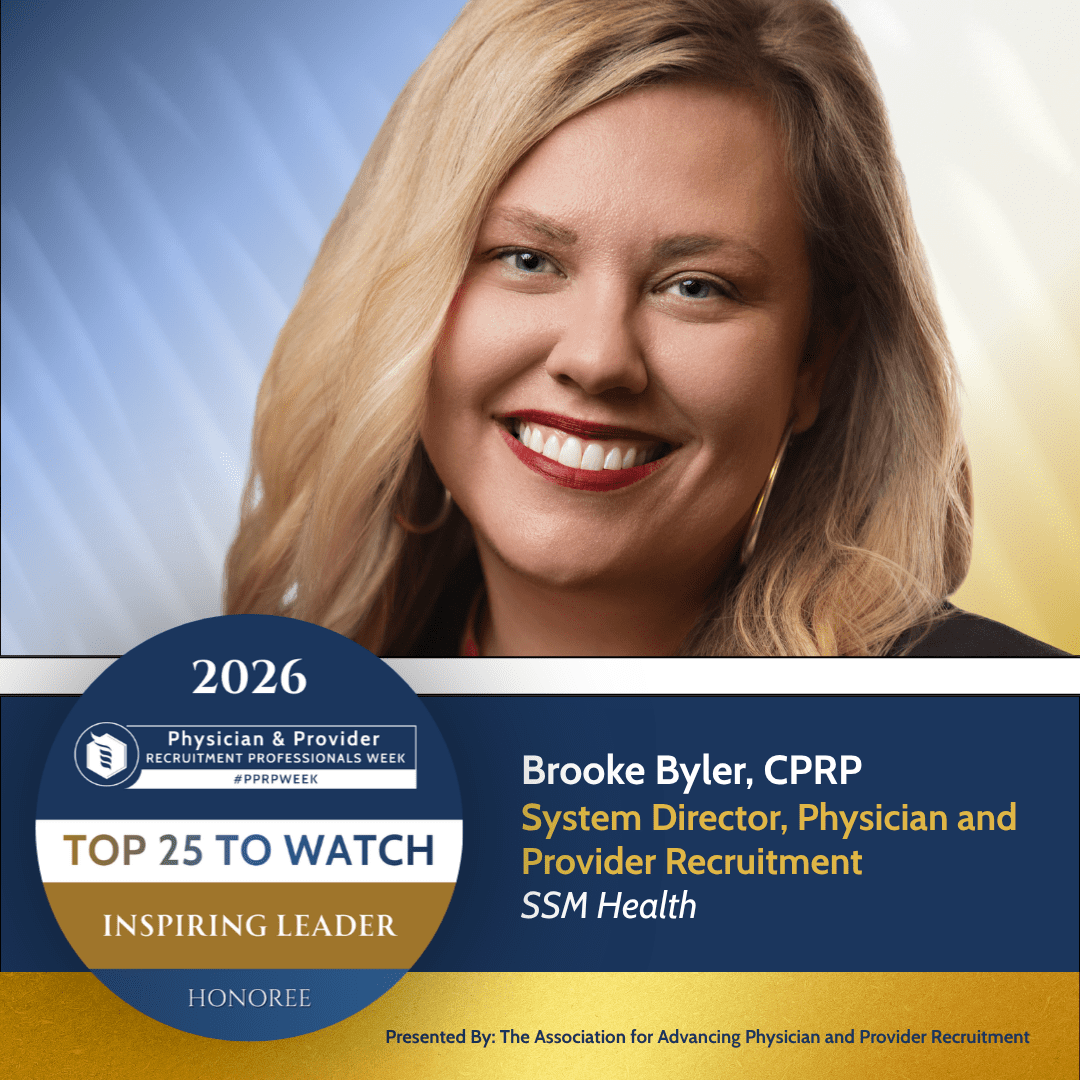
Brooke Byler, CPRPSystem Director, Physician and Provider Recruitment | SSM Health Brooke Byler is recognized as an Inspiring Leader for her exceptional leadership of a physician and provider recruitment team that spans four states within SSM Health. Since stepping into her role as System Director, Brooke has demonstrated a calm, thoughtful leadership style that prioritizes both people and results. She brings a steady presence to her team, ensuring that recruitment professionals feel supported while continuing to deliver strong outcomes for the organization. Her genuine care for her team and dedication to the profession have made her a trusted leader and role model for those around her. |
|
|
Priscilla Lyles, BSN, RN, RTR, CPRP-DEIDirector, Provider Recruitment and Integration | OSF HealthCare With more than 20 years of service to OSF HealthCare, Priscilla Lyles exemplifies leadership defined by compassion, authenticity, and a deep commitment to professional excellence. As Director of Provider Recruitment and Integration, Priscilla has cultivated a culture where team members feel valued, supported, and empowered to succeed. She actively encourages collaboration and ensures that every team member’s voice is heard in decision-making processes. Holding certifications including CPRP-DEI and OAR, Priscilla continuously invests in professional growth and inclusive leadership. Her impact extends beyond her organization through her role as Chair of ISPR, where she continues to advance the recruitment profession nationwide. |
|
|
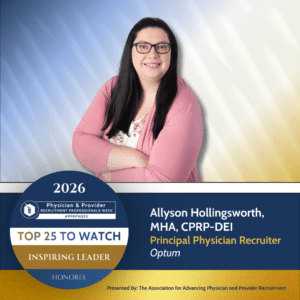
Allyson Hollingsworth, MHA, CPRP-DEIPrincipal Physician Recruiter | Optum Allyson Hollingsworth exemplifies excellence in physician and provider recruitment and serves as a strong ambassador for the profession. As a Principal Physician and Provider Recruiter at Optum, Allyson is known for building trusted relationships with hiring leaders and delivering recruitment strategies that improve both efficiency and the candidate experience. Her thoughtful, forward-looking approach to recruitment process improvement has made her a respected advisor within her organization. In addition to her professional contributions, Allyson is actively involved in AAPPR leadership, serving in local leadership roles and currently as a board member. Her dedication to advancing recruitment practices and supporting the broader recruitment community makes her an inspiring leader in the field. |
|
|
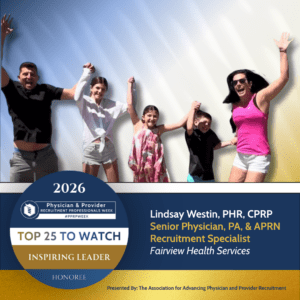
Lindsay Westin, PHR, CPRPSenior Physician, PA, & APRN Recruitment Specialist | Fairview Health Services Lindsay Westin is widely recognized by colleagues for the compassion, collaboration, and integrity she brings to physician and provider recruitment. Known for her ability to truly listen and understand the needs of both candidates and hiring leaders, Lindsay consistently creates meaningful connections that build trust and strengthen recruitment outcomes. Her collaborative approach ensures that teams work together to achieve the best possible results. Colleagues describe Lindsay as someone who elevates everyone around her. Her empathy, dedication to candidates, and willingness to support others make her an invaluable member of her team and a respected leader in the profession. |
|
|
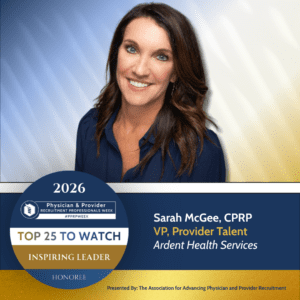
Sarah McGee, CPRPVice President, Provider Talent | Ardent Health Services Sarah McGee is recognized as an inspiring leader for the transformational impact she has had on the Provider Talent team at Ardent Health Services. Throughout her career, Sarah has demonstrated an unwavering commitment to excellence and a passion for developing strong recruitment teams. As Vice President of Provider Talent, she championed the creation of a “One Team” culture, strengthening collaboration across departments and improving alignment with organizational leadership. Her leadership has helped drive record-breaking outcomes for the organization while fostering a supportive and empowering environment for her team. Known for her accessibility, dedication, and people-first leadership style, Sarah continues to inspire those around her to grow, collaborate, and deliver exceptional results. |

Each year, Physician and Provider Recruitment Professionals (PPRP) Week serves as an opportunity to recognize and elevate the critical work done by recruitment professionals across the healthcare industry.
Every profession benefits from emerging leaders who bring energy, fresh perspectives, and a passion for making an impact. In physician and provider recruitment, these professionals are already demonstrating strong performance and leadership potential early in their careers.
The Rising Star category highlights emerging recruitment professionals who are early in their careers but already making a meaningful impact within their organizations and communities.
Below are the professionals recognized in the Rising Star category as part of the 2026 Top 25 Physician and Provider Recruitment Professionals to Watch.
|
|
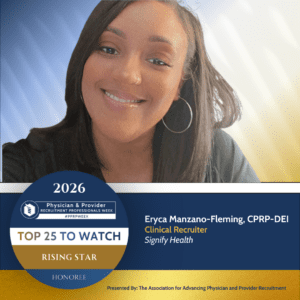
Eryca Manzano-Fleming, CPRP-DEIClinical Recruiter | Signify Health Eryca Manzano-Fleming embodies the mission of transforming healthcare one candidate at a time. As a Clinical Recruiter at Signify Health, she combines strong technical expertise across recruitment platforms with a thoughtful, human-centered approach to building healthcare teams. Holding her CPRP-DEI certification, Eryca brings a deep commitment to diversity, equity, and inclusion in every aspect of her work. Her ability to blend technology, strategy, and relationship-building allows her to identify and attract providers who strengthen healthcare organizations and improve patient access to care. Through her dedication to inclusive recruitment practices and continuous professional growth, Eryca represents the future of physician and provider recruitment. |
|
|
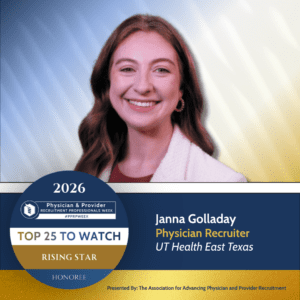
Janna GolladayPhysician Recruiter | UT Health East Texas Janna Golladay has quickly made a meaningful impact in physician and advanced practice provider recruitment at UT Health East Texas. Known for her strong work ethic and collaborative spirit, she approaches each search with enthusiasm and a commitment to supporting both candidates and her organization’s clinical teams. Janna has demonstrated an exceptional ability to build relationships with providers while helping guide them through the recruitment process. Her attention to detail and dedication to delivering a positive candidate experience have strengthened recruitment outcomes for her team. Her contributions to advanced practice provider recruitment have already made a noticeable difference, and her passion for the work continues to inspire those around her. |
|
|
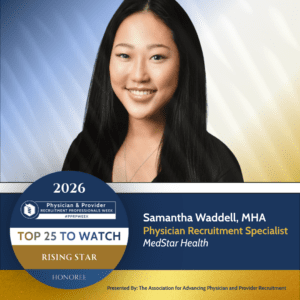
Samantha Waddell, MHAPhysician Recruitment Specialist | MedStar Health Samantha Waddell has emerged as a key contributor within the physician recruitment team at MedStar Health. As her team navigated the implementation of a new ATS and CRM, Samantha stepped forward proactively to deepen her understanding of the systems and provide valuable support to colleagues. Her exceptional talent for data analysis and reporting plays an important role in supporting departmental metrics and operational insights. Beyond her technical skills, Samantha is widely respected for her ability to build strong, authentic relationships with physicians and leadership across the organization. Having progressed from coordinator to physician recruitment specialist, Samantha demonstrates the dedication, initiative, and leadership potential that define a true Rising Star in the recruitment profession. |
|
|
Tasha Hruska, CPRPPhysician Recruiter | Prevea Health Tasha Hruska has quickly distinguished herself as a rising leader within the physician recruitment team at Prevea Health. After nearly a decade with the organization in various roles, she transitioned into the recruiter position in 2023 and has already made an exceptional impact. In a short time, Tasha earned her CPRP certification, took on a leadership role as chair of the events committee for her local WSPR chapter, and excelled as a full-cycle recruiter. Her ability to build trusted relationships with physicians and clinical leaders has made her a valued partner throughout the recruitment process. Candidates consistently highlight her professionalism, responsiveness, and support throughout their recruitment experience—testament to the care and dedication she brings to her work every day. |
|
|
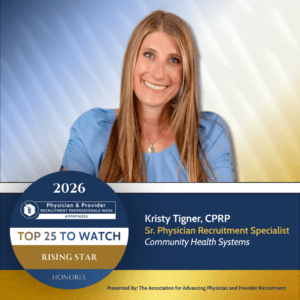
Kristy Tigner, CPRPSenior Physician Recruitment Specialist | Community Health Systems Kristy Tigner is an emerging professional whose leadership and strategic mindset are already making a lasting impact. She approaches recruitment with clarity, intention, and a commitment to advancing long-term workforce solutions. Kristy has played an important role in strengthening the cardiology physician pipeline for Community Health Systems. Her ability to balance big-picture strategy with the day-to-day demands of recruitment has helped drive momentum and accountability across her team. Known for her authenticity, collaboration, and dedication to excellence, Kristy consistently demonstrates that leadership is defined not by title, but by action and influence. Her trajectory points to a strong future as a leader in physician and provider recruitment. |
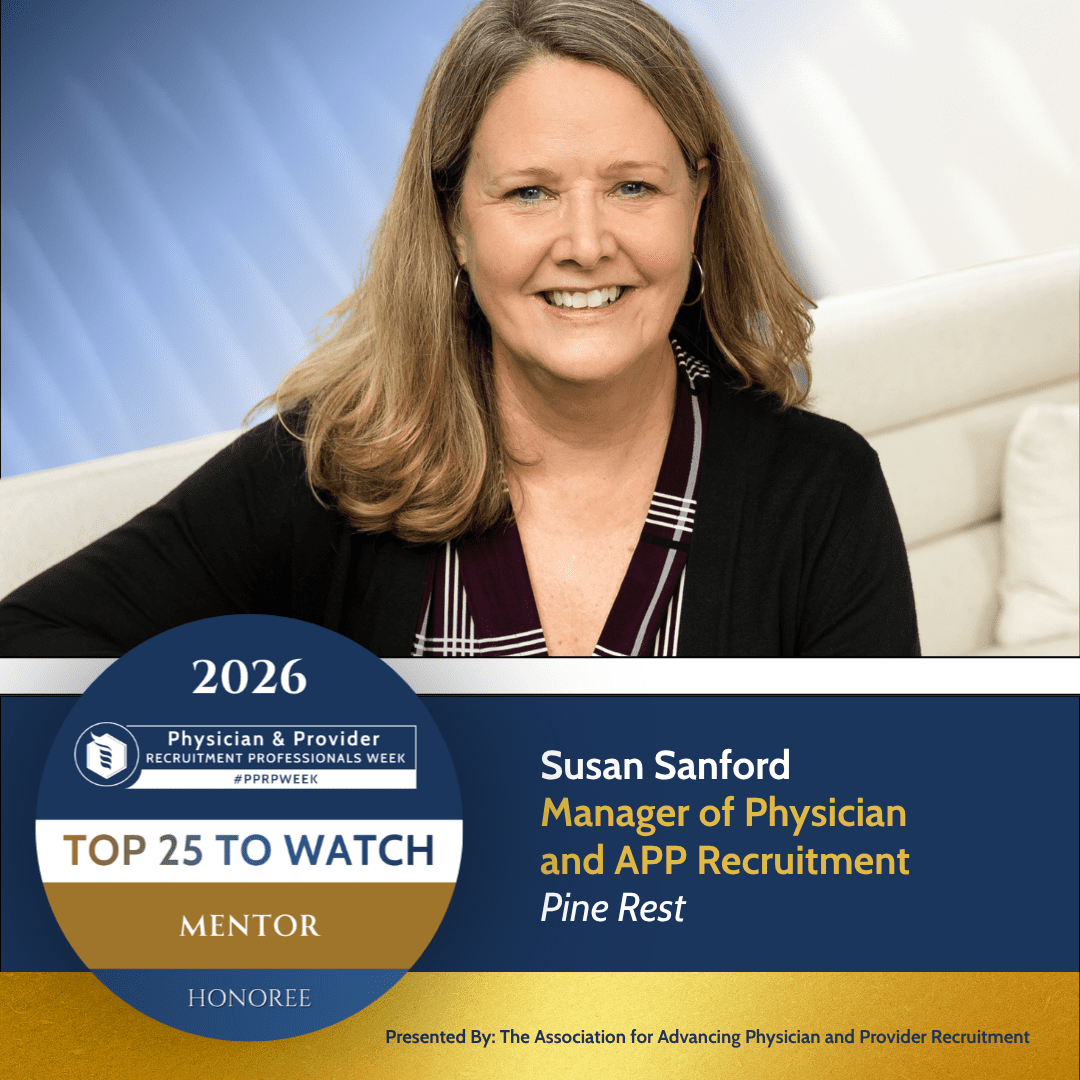
Each year, Physician and Provider Recruitment Professionals (PPRP) Week serves as an opportunity to recognize and elevate the critical work done by recruitment professionals across the healthcare industry.
Mentorship plays a critical role in strengthening the physician and provider recruitment profession. Experienced professionals who share their knowledge, guidance, and encouragement help cultivate the next generation of recruitment leaders.
The Mentor category celebrates professionals who are committed to guiding, supporting, and developing others in the recruitment field. Through their generosity, leadership, and willingness to invest in others, these individuals help elevate the entire profession.
Below are the professionals recognized in the Mentor category as part of the 2026 Top 25 Physician and Provider Recruitment Professionals to Watch.
|
|
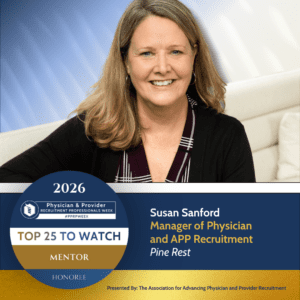
Susan SanfordManager of Physician & APP Recruitment | Pine Rest Join us in celebrating Susan Sanford, recognized as part of AAPPR’s Top 25 Physician and Provider Recruitment Professionals to Watch in the Mentor category. Susan has been a guiding force in the physician recruitment community for many years. Known for her willingness to share knowledge and support others, she has helped countless professionals grow in their careers. Her mentorship, leadership, and commitment to the profession continue to shape the next generation of recruitment professionals. |
|
|
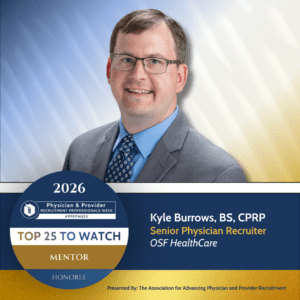
Kyle Burrows, BS, CPRPSenior Physician Recruiter | OSF HealthCare Join us in celebrating Kyle Burrows, BS, CPRP, recognized as part of AAPPR’s Top 25 Physician and Provider Recruitment Professionals to Watch in the Mentor category. Kyle is known for consistently supporting and mentoring colleagues while balancing the demands of a busy recruitment role. He generously shares his expertise, particularly during times of organizational change and integration. His approachable leadership style and dedication to helping others succeed make him a valued mentor and trusted resource. |
|
|
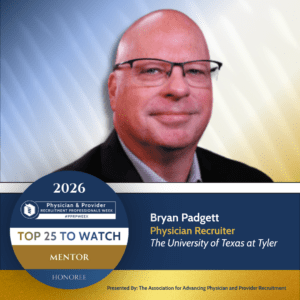
Bryan PadgettPhysician Recruiter | University of Texas at Tyler Join us in celebrating Bryan Padgett, recognized as part of AAPPR’s Top 25 Physician and Provider Recruitment Professionals to Watch in the Mentor category. Bryan brings deep expertise and a collaborative spirit to his work in physician recruitment. Colleagues appreciate his willingness to share ideas, brainstorm solutions, and support team success. His dedication and positive influence make him an important mentor within his organization. |
|
|
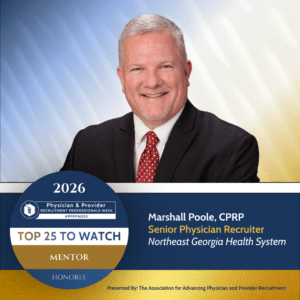
Marshall Poole, CPRPSenior Physician Recruiter | Northeast Georgia Health System Join us in celebrating Marshall Poole, CPRP, recognized as part of AAPPR’s Top 25 Physician and Provider Recruitment Professionals to Watch in the Mentor category. Marshall recently celebrated an incredible milestone—his 500th provider hire. Beyond the numbers, his work has expanded access to care for communities across the region. Through his service with the Southeast Physicians Recruiters Association and his commitment to mentoring colleagues, Marshall continues to elevate the recruitment profession. |
|
|
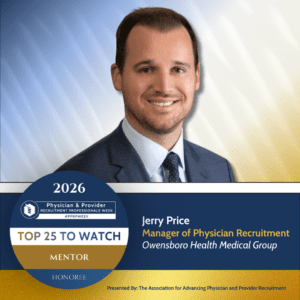
Jerry PriceManager of Physician Recruitment | Owensboro Health Medical Group Join us in celebrating Jerry Price, recognized as part of AAPPR’s Top 25 Physician and Provider Recruitment Professionals to Watch in the Mentor category. Jerry is known for his calm leadership style and dedication to helping others grow in the field of physician recruitment. He has played a pivotal role in mentoring colleagues transitioning into recruitment roles and ensuring they feel confident and supported. His guidance and encouragement have helped shape successful careers and strengthen recruitment teams. |

Each year, Physician and Provider Recruitment Professionals (PPRP) Week serves as an opportunity to recognize and elevate the critical work done by recruitment professionals across the healthcare industry.
Innovation drives the future of physician and provider recruitment. As healthcare continues to evolve, recruitment professionals must develop creative strategies, leverage new technologies, and rethink traditional approaches to attract and retain top clinical talent.
The Innovator category recognizes recruitment professionals who bring new ideas, creative strategies, and forward-thinking approaches to physician and provider recruitment. These individuals are not afraid to challenge the status quo and are helping their organizations and the profession move forward.
Below are the professionals recognized in the Innovator category as part of the 2026 Top 25 Physician and Provider Recruitment Professionals to Watch.
|
|
Abigail Holland, CPRPProvider Recruitment Partner | Trinity Health Join us in celebrating Abigail Holland, CPRP, recognized as part of AAPPR’s Top 25 Physician and Provider Recruitment Professionals to Watch in the Innovator category. Abigail consistently demonstrates excellence in physician and provider recruitment through her professionalism, attention to detail, and strong relationship-building skills. She approaches every search with a candidate-first mindset while balancing the needs of physicians, leaders, and the communities they serve. Her dedication, collaboration, and ability to navigate a competitive recruitment environment make a meaningful impact on her organization and the profession. |
|
|
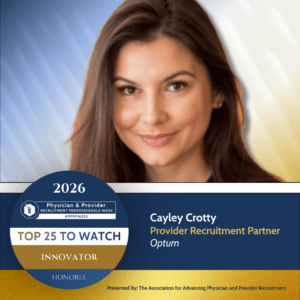
Cayley CrottyPrincipal Provider Recruiter | Optum Join us in celebrating Cayley Crotty, recognized as part of AAPPR’s Top 25 Physician and Provider Recruitment Professionals to Watch in the Innovator category. Cayley leads with curiosity and a genuine desire to improve experiences for both colleagues and candidates. Through peer-led employee listening sessions and thoughtful adoption of tools like AI, she has created meaningful improvements in collaboration, efficiency, and recruitment processes. Her creativity, generosity in sharing knowledge, and commitment to innovation make her a standout professional in physician and provider recruitment. |
|
|
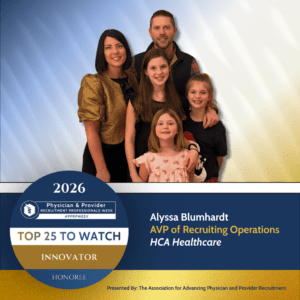
Alyssa BlumhardtAVP of Recruiting Operations | HCA Healthcare Join us in celebrating Alyssa Blumhardt, recognized as part of AAPPR’s Top 25 Physician and Provider Recruitment Professionals to Watch in the Innovator category. Alyssa has helped transform how strategy, technology, and operations work together in physician and provider recruitment. Her leadership has driven major improvements in data reporting, recruitment workflows, sourcing strategies, and enterprise recruitment systems. By building scalable, data-driven infrastructure that supports organizational growth and improved patient access to care, Alyssa has set a new standard for recruitment innovation. |
|
|
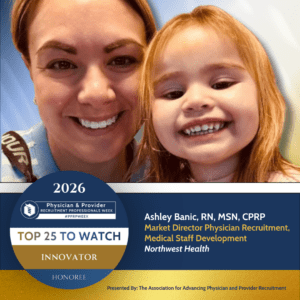
Ashley Banic, RN, MSN, CPRPMarket Director Physician Recruitment | Northwest Health Join us in celebrating Ashley Banic, RN, MSN, CPRP, recognized as part of AAPPR’s Top 25 Physician and Provider Recruitment Professionals to Watch in the Innovator category. Ashley brings creativity, strategic insight, and forward-thinking recruitment approaches to physician and provider recruitment. She has a unique ability to reimagine traditional strategies while building meaningful relationships with candidates and leadership partners. Her professionalism, passion, and commitment to long-term recruitment success make her a standout leader in the field. |
|
|
Shawna Roach, MHA, CPRPEnterprise Manager – Clinician Sourcing | Pediatric Associates Join us in celebrating Shawna Roach, MHA, CPRP, recognized as part of AAPPR’s Top 25 Physician and Provider Recruitment Professionals to Watch in the Innovator category. In a short time with Pediatric Associates, Shawna has brought tremendous value through creative sourcing strategies and a strong focus on measuring return on investment. As a working manager, she continually develops new ideas to help her team succeed. Her strategic thinking and innovative mindset are already making a significant impact on her organization’s recruitment efforts. |
AAPPR uses cookies for functional and analytical purposes. By continuing to browse or by clicking “Accept,” you agree to the storing of cookies on your device to enhance your site experience. To learn more about how we use cookies or how to change your settings, please see our privacy policy.
Accept Close